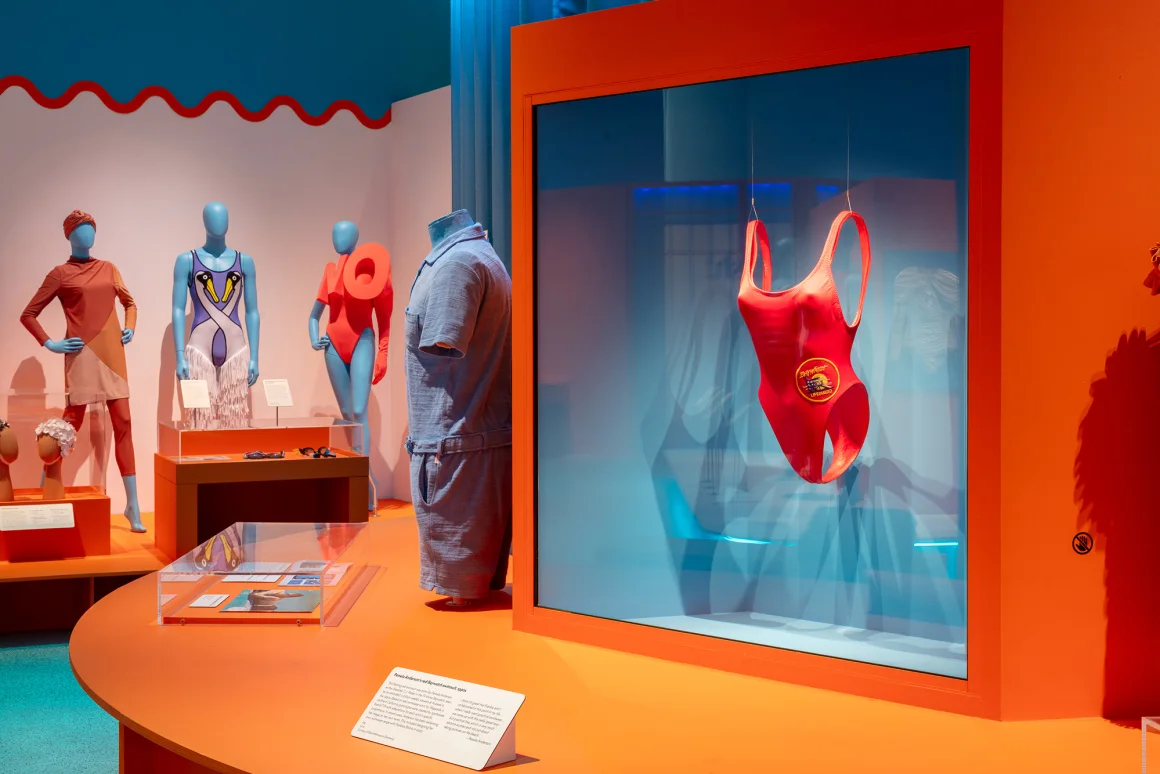

Pamela Anderson’s iconic red swimsuit from her tenure on “Baywatch” (1992-1997) remains one of the most memorable pieces of television fashion. This legendary garment is now a highlight of the “Splash! A Century of Swimming and Style” exhibition at The Design Museum in London, running until August 17. Suspended in a glass case on an invisible mannequin, the swimsuit’s historical significance extends beyond its on-screen fame.
Curator and fashion historian Amber Butchart noted the garment’s cultural impact and high insurance cost. She acknowledged how it represented ‘90s beauty standards, shaped by the male gaze, but praised Anderson’s successful redefinition of her image. Starting as lifeguard C.J. Parker, Anderson propelled “Baywatch” to global success, making it the most-watched TV show in the world with over a billion viewers in 140 countries. Broadcasters often insisted on purchasing only the episodes featuring Anderson, a demand referred to as “Pamela Clauses.” To celebrate the show’s 30th anniversary in 2019, Pantone introduced the shade “Baywatch Red.”
All “Baywatch” swimsuits were custom-made by TYR, designed to emphasize the actors’ physiques. Displaying the swimsuit required careful consideration, as a standard mannequin wouldn’t do it justice unless it mirrored Anderson’s exact proportions. Instead, the piece is exhibited as an independent object, highlighting its cultural significance.
The exhibition traces the evolution of swimwear from the heavy woolen unitards of the 1920s to the first modern bikini in 1946—named after the nuclear testing site Bikini Atoll for its “explosive” effect—before progressing to Speedos and high-fashion scuba-inspired couture by Viktor & Rolf. More than a showcase of style, the exhibition examines swimwear’s social impact. One notable artifact is a century-old rental bathing suit labeled “Margate Corporation,” once provided by local councils to those who couldn’t afford their own swimwear.
Modern brands now embrace inclusivity, with gender-neutral options from Beefcake Swimwear and adaptive designs by Girls Chronically Rock catering to diverse body types and physical abilities. The exhibition also addresses past beauty standards, with vintage ads promoting depilatory creams and magazines dictating rigid grooming expectations. Anderson’s swimsuit, with its high-cut leg, reflects the bold aesthetic of ‘80s and ‘90s swimwear, a style experiencing renewed popularity today.
A placard beneath the swimsuit features Anderson’s quote about her own swimwear line, designed with Francesca Aiello, emphasizing practicality over aesthetics. Butchart felt it was essential to include Anderson’s voice in the exhibition, recognizing her journey from ‘90s icon to a woman reclaiming her narrative on her own terms.
READ MORE: