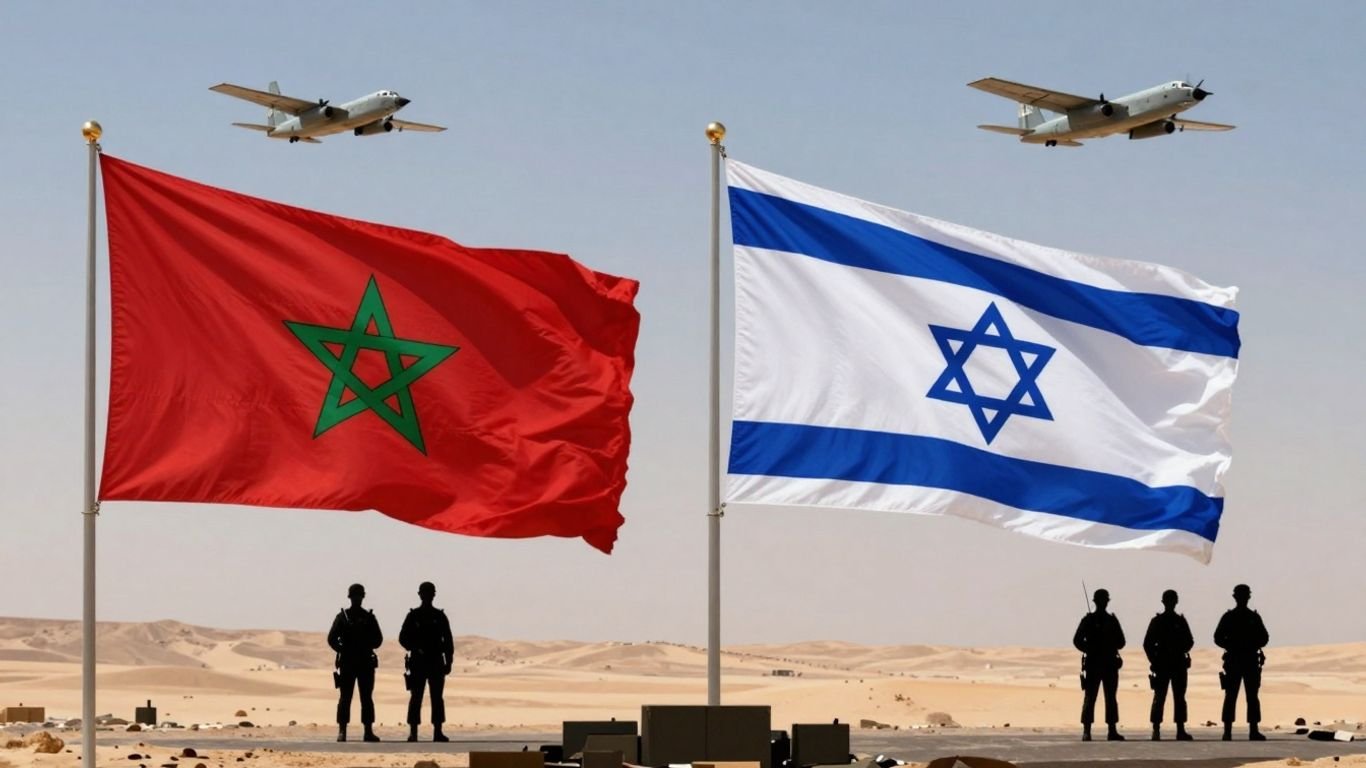

Morocco and Israel have solidified their military partnership, signing a joint military “work plan” for 2026 during the third Joint Military Committee meeting in Tel Aviv. This move, occurring five years after the establishment of diplomatic relations under the Abraham Accords, signals an enhanced focus on advanced defense technologies, including drones and air defense systems, and comes amidst ongoing regional tensions.
Enhanced Defense Collaboration
Recent discussions between Moroccan and Israeli military officials have centered on strategic objectives, IDF unit visits, and coordinated security efforts. A significant outcome of the latest meeting is the commitment to jointly develop future technologies, including drones, air defense systems, and satellite technology. This represents a qualitative leap in their defense cooperation, moving beyond mere technological deliveries.
Morocco, a major global arms importer, has increasingly relied on Israel as a key supplier since 2020. Israel’s contributions are particularly notable in air defense and unmanned systems, with reports indicating that over half of the defense missiles supplied to Morocco originate from Israel. This collaboration is also bolstering Morocco’s domestic drone production capabilities.
Regional Implications and Geopolitical Dynamics
The deepening military ties between Morocco and Israel carry significant regional weight. The normalization, facilitated by the US-brokered Abraham Accords, has been a diplomatic success for Morocco, particularly as Israel recognized Moroccan sovereignty over the Western Sahara region. This stance, also supported by the US and several Western European nations, has intensified tensions with Algeria, which backs the Polisario Front‘s independence movement in the territory.
Furthermore, Morocco’s modernized military, bolstered by Israeli defense technology, is now considered superior to Algeria’s armed forces. While Algeria reportedly possesses advanced Russian weaponry, the strategic balance appears to be shifting.
Historical Context and Public Sentiment
Despite the ongoing conflict in Gaza and widespread public solidarity with the Palestinians in Morocco, the normalization with Israel has faced relatively muted societal resistance. This is partly attributed to long-standing, albeit unofficial, relations between the two nations, influenced by the significant Moroccan Jewish diaspora in Israel. Unlike some other Arab states, Morocco did not engage in large-scale expulsions of its Jewish population in the mid-20th century, fostering less strained societal connections.
However, the war in Gaza has impacted bilateral relations, leading to the suspension of direct flights and unmet expectations for Israeli tourism. Economically, Israel maintains significant interests in Morocco, particularly in agriculture, leveraging Moroccan demand for advanced irrigation techniques and expertise in arid-zone cultivation. Morocco’s phosphate deposits also present an attractive opportunity for Israeli companies involved in fertilizer production.