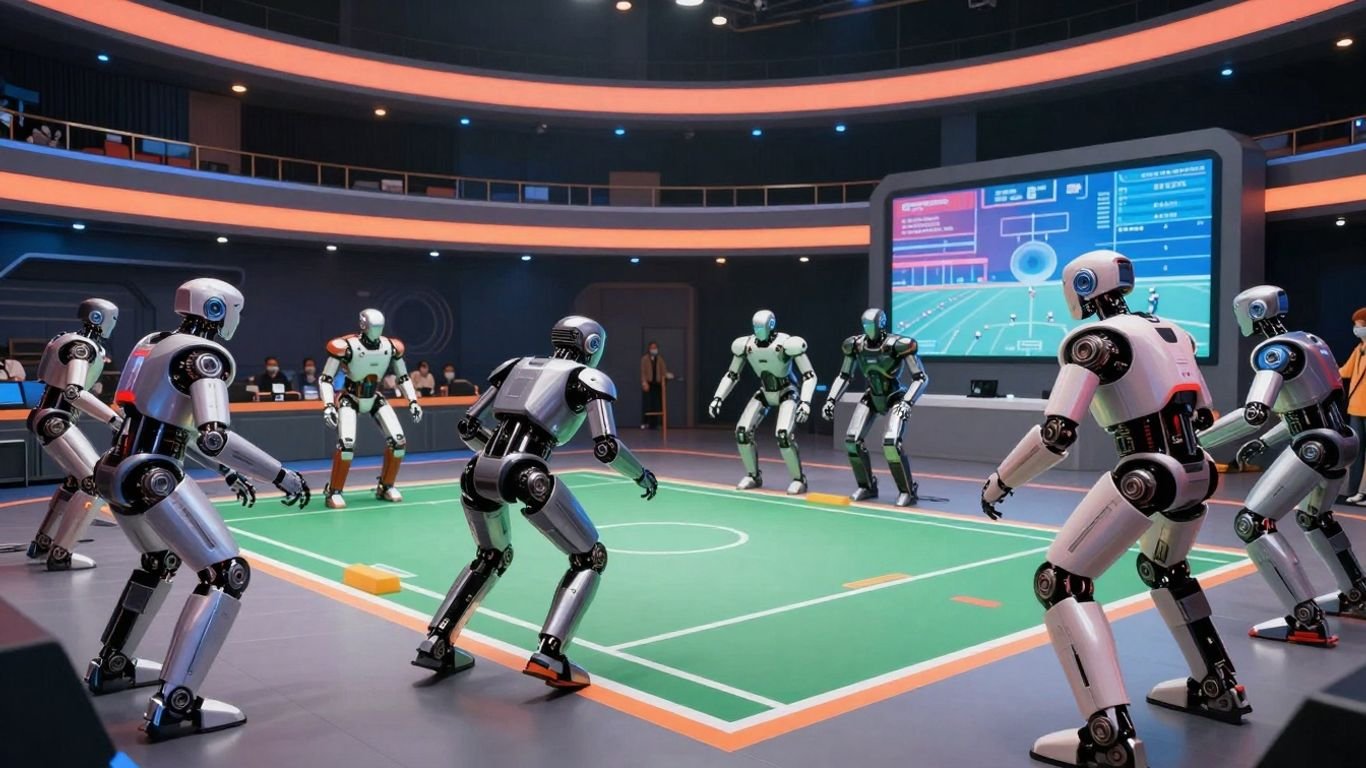

On the outskirts of Beijing, a new kind of athlete is taking the field – humanoid robots. China is rapidly advancing its humanoid robot technology, with sports competitions serving as a crucial testing ground. These events showcase the capabilities of increasingly sophisticated machines, hinting at a future where these advanced robots could become commonplace in homes.
The Rise of Robot Sports
China’s commitment to robotics, identified as a key sector for industrial upgrading since 2015, has led to a surge in humanoid robot companies. These companies are increasingly using sports as a platform to demonstrate their creations. In 2025, China witnessed a boom in robot sporting events, including synchronized dancing robots at the Spring Festival Gala, humanoids completing a half-marathon, and the inaugural World Humanoid Robot Games in Beijing. These games featured competitions in soccer, boxing, and martial arts, pushing the machines to their limits.
Soccer: A Benchmark for Advancement
Soccer has long been a benchmark for robot development, with the RoboCup competition dating back to the late 1990s. This sport demands a complex array of capabilities, including advanced motion, vision, localization, strategic planning, and adversarial reasoning. The ambitious goal of RoboCup is to eventually create a robot team capable of defeating the best human soccer team. For entrepreneurs like Cheng Hao, founder of Booster Robotics, these sports are not just about competition but also about testing and refining the AI and engineering that will power future applications.
From Pitch to Practicality
While robot sports are a spectacle that attracts attention and investment, the underlying technology has broader implications. Companies are already testing their robots in simulated factory environments for tasks like material handling and sorting. The vision extends beyond industrial use, with aspirations for robots to become integrated into daily life. Cheng Hao envisions robots as “intelligent agents” that could serve as workout companions, home tutors, or even household assistants, making them as accessible and practical as personal computers.
Government Support and Future Outlook
The Chinese government has been instrumental in fostering the robot industry through strategic blueprints, financial incentives, and extensive media coverage of robot sports. The World Humanoid Robot Games, co-hosted by government entities and state broadcasters, exemplify this support. While government backing is currently significant, the long-term aim is for the industry to become self-sustaining. Despite current challenges, such as robots occasionally crashing or falling, these events are crucial for identifying flaws and driving technological improvements, paving the way for more capable and versatile humanoid robots in the future.