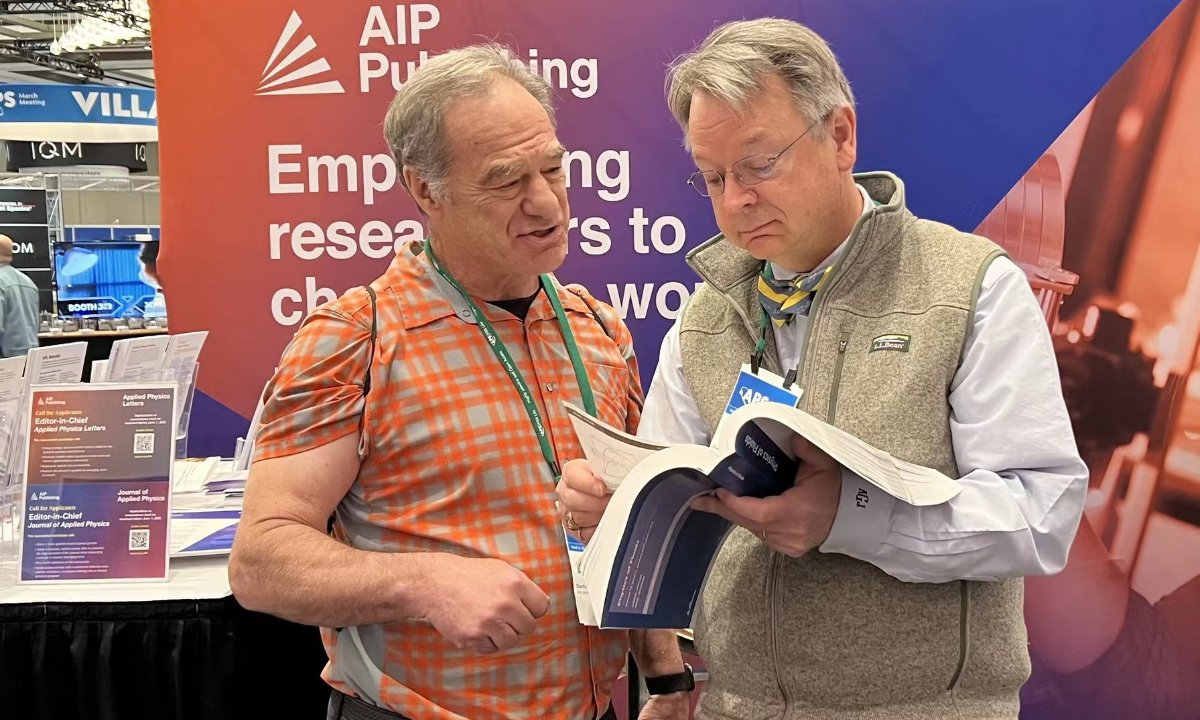

Recent conversations with leaders from AIP Publishing highlight the transformative role of academic publishing in amplifying China’s scientific research influence on the global stage. Alexandra Vance, CEO of AIP Publishing, and Alan Jeffrey Giacomin, Editor-in-Chief of Physics of Fluids, provided insight into a range of topics, from the factors behind China’s impressive scientific output to the future of Sino-US technological collaboration.
Vance emphasized the importance of academic publishing in promoting robust scientific communication, describing it as a bridge for the exchange of research, ideas, and knowledge that cuts across geographical and cultural barriers. Through such publishing, Chinese scientists can share their groundbreaking findings with an international audience, simultaneously gaining recognition and ensuring that the global community has access to China’s rapid advancements in various scientific fields.
Highlighting China’s recent achievements, Vance pointed out that in 2022, China became the largest contributor of research in major science journals worldwide. Papers by Chinese scholars in physical sciences have grown impressively both in terms of quantity and quality over the past decade. In AIP Publishing alone, there has been a striking 35% surge in publications authored by Chinese researchers in the last ten years. This can be attributed to increased commitment, funding, infrastructure, and a broader scope of research topics pursued by Chinese scholars.
Giacomin observed the evolution in the quality and quantity of contributions from Chinese researchers in the field of fluid mechanics. He noted that improvements in language proficiency have significantly contributed to advancements in China’s scientific research and development. Furthermore, Giacomin remarked that while China has established itself as a leading contributor, it’s crucial to recognize that the scientific community is a global network, with contributions coming from around the world.
Regarding global collaboration, Vance highlighted the fruitful partnerships AIP Publishing has forged with Chinese institutions. These collaborations have resulted in a notable increase in submissions, publications, and impact factors. These partnerships not only enhance the reputation of Chinese researchers and organizations but also foster mutual growth in the scientific landscape.
When asked about the significance of publishing in top journals, Giacomin conveyed the global nature of such publications, underscoring that they belong to the worldwide scientific community. He emphasized the rising contributions from China and AIP Publishing’s commitment to supporting researchers globally.
A key topic discussed was the influence of Artificial Intelligence (AI) on scientific research and academic publishing. Vance elaborated on the emergence of AI-integrated research, referencing AIP’s introduction of a new open access journal that explores the synergy between machine learning and traditional scientific disciplines. AI is also beginning to find its footing in peer reviews and automated editing in academic publishing. However, Giacomin expressed skepticism about the current capabilities of AI tools like ChatGPT for research writing, citing human-led writing services as being superior in clarity and understanding.
In summary, these insights from AIP Publishing’s leaders demonstrate a promising horizon for Chinese scientific research on the global stage, emphasizing collaboration, mutual growth, and the pivotal role of academic publishing in shaping the future of science.
READ MORE: