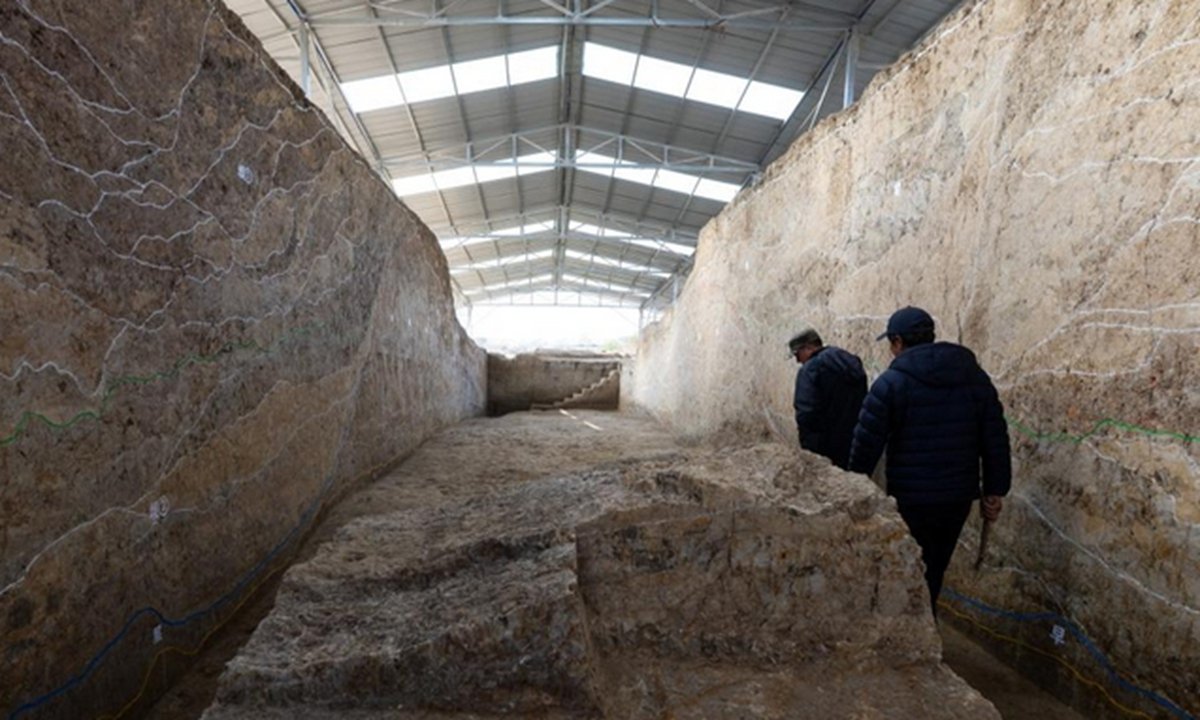

Archaeologists in Jingmen, Central China’s Hubei Province, have uncovered a significant archaeological find at the Qujialing relics site: a large-scale dam system dating back approximately 5,100 years. This discovery, announced during a recent meeting of archaeologists, marks the earliest known water conservancy project in China.
The excavations have also revealed a 5,500-year-old settlement from the Youziling Culture along the Yangtze River’s middle reaches. This ancient settlement comprises a comprehensive water management system, burial area, residential zone, and pottery production area, offering a window into the sophisticated societal structures of early Chinese civilizations.
Tao Yang, a researcher at the Hubei Provincial Institute of Cultural Relics and Archaeology, explained that the discovery of the dams signifies a pivotal shift in ancient Chinese society. It represents a transition from passive flood prevention methods to proactive water control and utilization strategies. This change marks a significant adaptation from merely adapting to natural forces to actively transforming and harnessing them.
The Qujialing site’s archaeological findings provide insights into the planning concepts, evolution, and social structure traditions of large settlements in the Yangtze River’s middle reaches. It underscores a civilization unique to the region, offering a critical sample for studying prehistoric water control societies’ formation and the origin and evolution of civilizations in this area.
The unearthed water conservancy system comprises a reservoir, spillway, drought and flood protection systems, with irrigation channels being the most utilized component. The existing dam, impressively, measures 2 meters in height, 13 meters in width, and 180 meters in length. The reservoir, located east of the dam, includes a spillway on its northern side to manage excess water during floods.
He Nu, a researcher from the Chinese Academy of Social Sciences’ Institute of Archaeology, noted that these findings demonstrate ancient people’s ability to harness water based on the local terrain, moving beyond simple flood defense.
Adjacent to a western dam, a large irrigation system suggests the existence of prehistoric rice paddies. Luo Yunbing, deputy dean of the Hubei Provincial Institute of Cultural Relics and Archaeology, indicated that this system was primarily used for irrigation, closely tied to early crop cultivation in the region. This discovery highlights the significant role of agricultural production in supporting the transition of societies during this era, reflecting the mobilization capacity of early social organizations.
Further findings include the emergence of class divisions, or so-called wang, during the Qujialing culture (3,400-2,600 BC), as noted by professor Zhao Bingfu of Jilin University. Liu Bing, a professor at Zhejiang University, concurred, suggesting that the size of the water management system correlated with the extent of social organization in the region.
Additionally, broken pottery from different dam periods and high-grade buildings were found near the Xiongjialing Dams, adding to the site’s archaeological richness.
The Qujialing culture, named after its first discovery at the Qujialing relics site, was a Neolithic civilization primarily centered in the middle Yangtze River region in Hubei. It stands as a prominent research site for exploring the origins of civilizations in this river’s middle reaches. The recent discoveries at the Qujialing relics site not only provide a deeper understanding of ancient Chinese water management techniques but also offer invaluable insights into the societal and cultural dynamics of early civilizations in the region.
READ MORE: