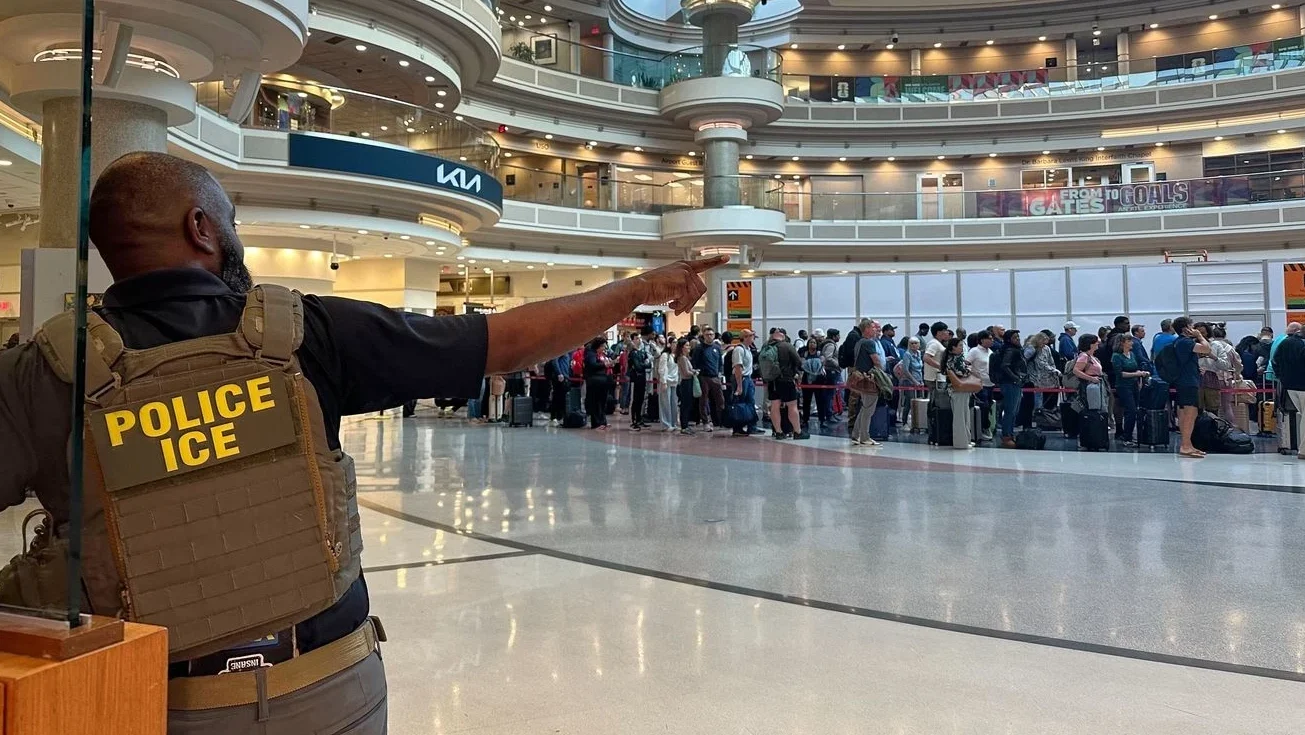

President Trump announced the deployment of U.S. Immigration and Customs Enforcement (ICE) agents to airports nationwide starting Monday, March 23, 2026. This move comes as a partial government shutdown of the Department of Homeland Security (DHS) continues, leading to significant disruptions and long wait times at Transportation Security Administration (TSA) checkpoints. The decision has drawn sharp criticism from Democrats and union representatives, who question the training and role of ICE agents in airport security.
The partial government shutdown, which began in mid-February, has severely impacted DHS operations, including the TSA. With many TSA officers working without pay, absenteeism has increased, and hundreds have resigned. This has resulted in unprecedentedly long security lines at major airports across the country, causing significant inconvenience for travelers, especially during peak travel seasons.
President Trump announced on social media that ICE agents would be sent to airports to support TSA officers. Tom Homan, identified as the “border czar,” confirmed the plan, stating that ICE agents would not be directly involved in passenger screening but would assist by managing entry and exit points, thereby freeing up TSA agents for their primary screening duties. The administration asserts this is a necessary measure to ensure the safety and efficiency of air travel while Congress fails to reach an agreement on DHS funding.
The deployment has been met with strong opposition. The union representing TSA officers stated that their members “deserve to be paid, not replaced by untrained, armed agents.” Critics, including the American Civil Liberties Union (ACLU) and various Democratic lawmakers, have raised concerns about the lack of specific training for ICE agents in airport security protocols. They argue that this move could potentially create new security risks and that ICE agents have a history of misconduct. Some also view the deployment as a political maneuver to pressure Democrats into accepting the administration’s funding demands without reforms.
The core of the shutdown lies in a disagreement over funding for DHS. Republicans advocate for a comprehensive funding package, while Democrats are demanding reforms to ICE operations before approving additional funds. The dispute has been exacerbated by recent incidents involving federal immigration agents, leading Democrats to push for greater accountability and oversight of these agencies.