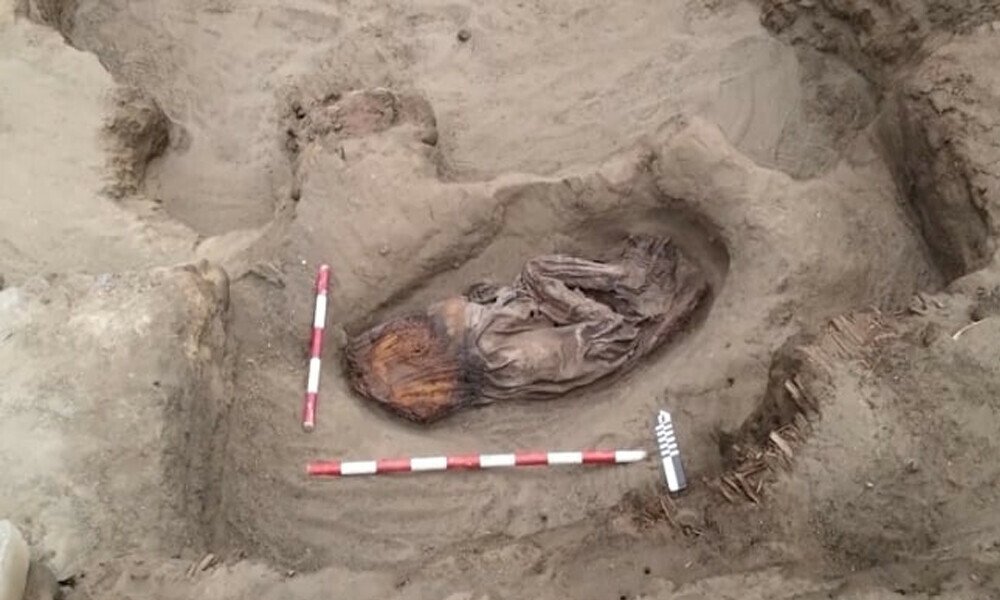

Archaeologists working along Peru’s coast have uncovered the 5,000-year-old remains of a woman believed to have been a member of the elite class of the ancient Caral civilization. This discovery highlights the significant role women may have held in one of the oldest known cities in the Americas. Caral, located roughly 180 kilometers north of Lima, thrived around the same period as ancient Egypt, China, and Sumer, yet developed entirely independently without external influence. The burial site was found in Aspero, a part of the Caral complex that was once used as a municipal dump.
The archaeologists noted that the condition and presentation of the burial suggest the woman was of high status. Her body, remarkably preserved with visible skin, hair, and nails, was carefully wrapped, indicating a respectful and elaborate burial practice. She was likely between 20 and 35 years old at the time of her death. Covering her remains was a mantle adorned with blue and brown feathers, possibly from Amazonian birds such as the macaw, suggesting connections or trade with distant regions. Surrounding her tomb were baskets filled with offerings, as well as vases, gourds, and even a toucan’s beak, further supporting the theory of her elevated social standing.
Researchers emphasized that this find is particularly significant in shedding light on the societal structure of Caral. It challenges previous assumptions that leadership and influence were male-dominated, showing that women, too, held prominent and complementary roles within this ancient civilization. The burial’s elaborate nature and the symbolic artifacts accompanying the woman underscore the high regard in which she was held by her community.
Although the exact date of the burial is still undetermined, it falls within the period when the Caral civilization was flourishing around 3,000 B.C. This discovery adds a new dimension to the understanding of early civilizations in the Americas and their social dynamics, illustrating that gender roles may have been more balanced than previously thought. The presence of items from the Amazon hints at Caral’s extensive networks and sophisticated cultural practices long before modern connectivity.
READ MORE: