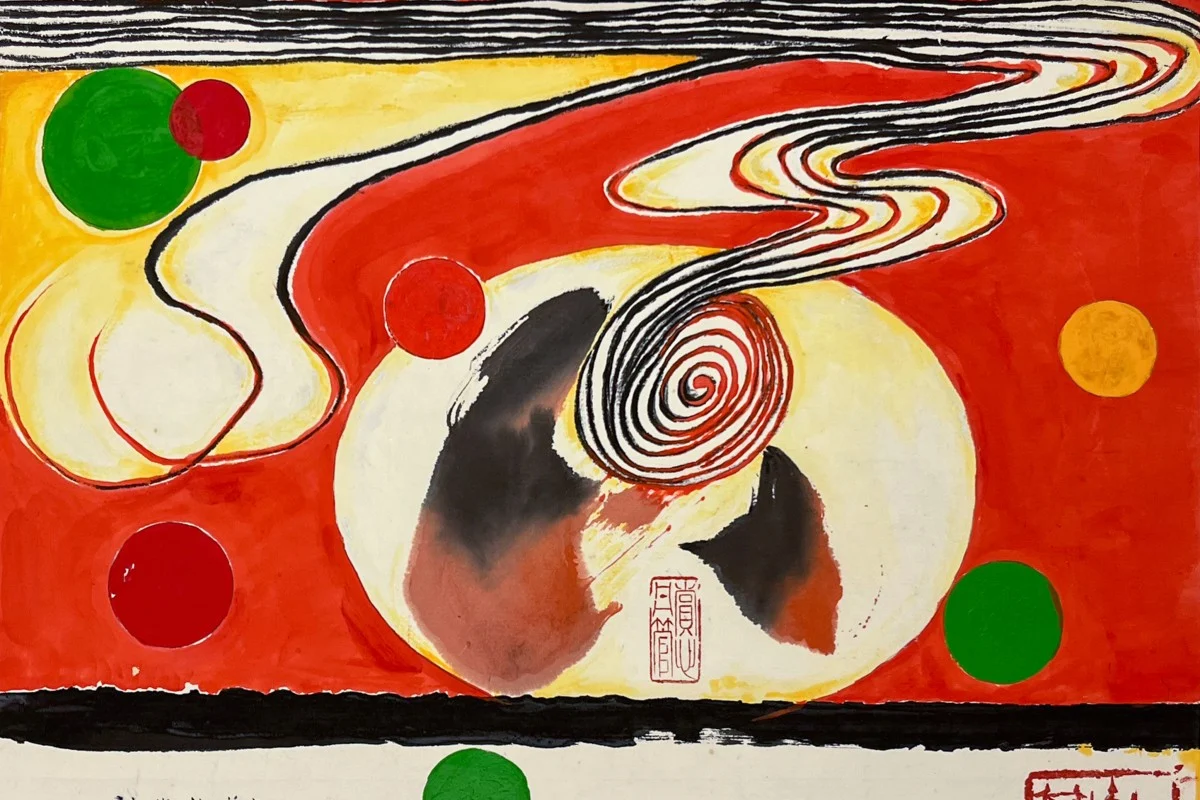

Fifty years after his passing, Lui Shou-kwan continues to be revered as a pioneering force in Hong Kong’s modern art scene. Best known for challenging traditional Chinese ink painting methods, Lui encouraged innovation over imitation. A self-taught artist who worked as a ferry company inspector before dedicating himself to teaching, Lui influenced generations of artists through his roles at the Chinese University of Hong Kong and the University of Hong Kong. Rejecting the conventional practice of copying classical masters, he pushed students to develop individual styles and explore new ideas.
Among Lui’s most celebrated students is Wucius Wong, born in Guangdong in 1936, who studied with him in the late 1950s. Wong later studied in the United States, where Bauhaus design principles inspired a style that combined Western abstraction with Chinese landscape traditions. Rather than reconciling both worlds, Wong emphasized their tension, becoming a key figure in the Hong Kong New Ink Movement.
Kan Tai-keung, born in 1942, also studied under Lui and Wong, merging traditional ink aesthetics with modern graphic design. His dual talents culminated in high-profile works such as the Bank of China’s 1989 logo, blurring the lines between fine art and commercial design.
Leung Kui-ting, born in 1945, was among Lui’s last students. His work—marked by abstract geometric forms layered onto traditional rice paper—was so radical that even Lui questioned it. However, Leung’s exploration of impermanence echoes his teacher’s spiritual inclinations, especially those expressed in Lui’s Zen series.
Irene Chou, born in 1924, began as a journalist before transitioning to art. After training under Zhao Shao-ang and later Lui, she developed a deeply expressive style that fused traditional Chinese brushwork with Western abstract expressionism. Her signature “one-stroke technique” drew from Zen and Taoist philosophies, emphasizing spontaneity and inner vision. She once reflected on Lui’s challenge to redefine ink painting outside of its 2,000-year-old tradition, a question that propelled her and many of her peers toward artistic liberation.
Through his teachings and philosophy, Lui Shou-kwan laid the foundation for a distinctly Hong Kong style of contemporary ink painting, leaving a legacy that continues to shape the region’s artistic identity.
READ MORE: