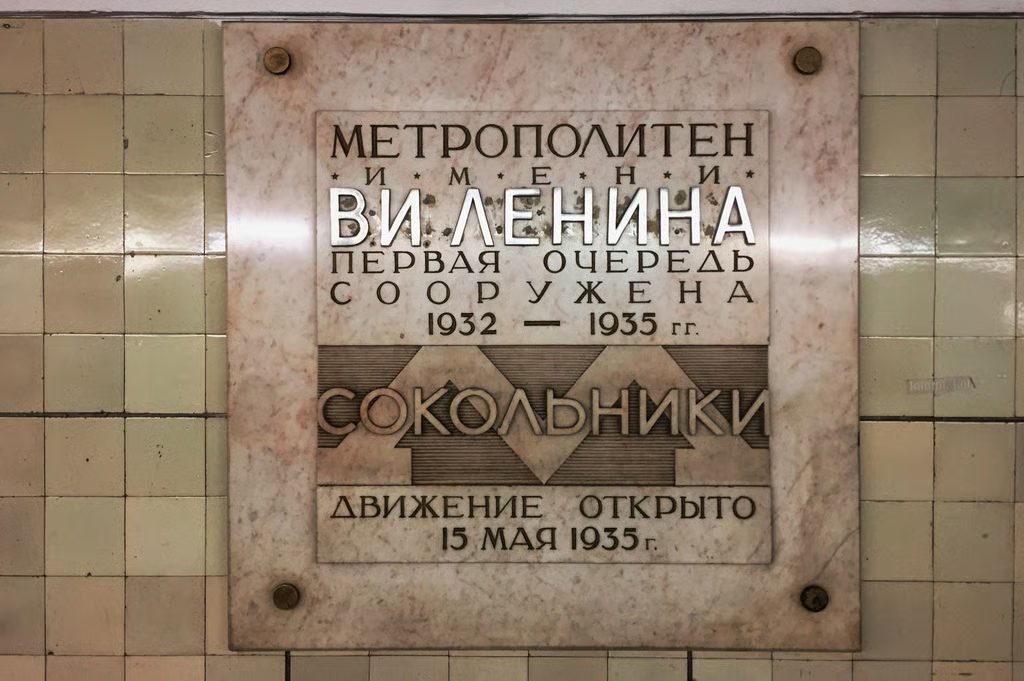

A marble plaque at Sokolniki station marks the beginning of one of the world’s most iconic underground railways, which opened on May 15, 1935. While it was designed by Lazar Kaganovich, a close associate of Stalin, his name is absent from the plaque—replaced with metal letters honoring V.I. Lenin. Today, the Moscow Metro continues to impress with its blend of historic grandeur and modern efficiency.
Now spanning around 472 kilometers with 302 stations—120 of which have opened since 2010—the metro serves over nine million passengers daily. Despite its late start compared to older systems in London, Paris, or Budapest, Moscow’s underground railway was conceived as more than just a means of transport. Stalin envisioned it as a monument to socialism, a series of subterranean palaces that would awe citizens and reflect ideological superiority. The ornate stations, mosaics, and Socialist Realist sculptures remain testaments to this vision.
Tour guide and engineer Daniil Shopkhoev highlights many of these features, such as the majestic galleries of Komsomolskaya station and the life-sized sculptures at Revolution Square. Despite their aesthetic brilliance, the construction of these stations came at a great human cost. Workers faced perilous conditions, and many died due to groundwater and unstable geology.
The metro has evolved over time, especially after Stalin’s death in 1953. Under Khrushchev, extravagance gave way to functionality, but the core emphasis on beauty and durability remains. The system has even served a dual purpose: some stations are equipped to act as nuclear bunkers, built deep underground to offer protection during emergencies. This dual-use design is echoed in Kyiv and Tbilisi, whose metro systems were inspired by Moscow’s.
Today, the metro is a lifeline for Muscovites, providing cool refuge in summer and warmth in winter, with trains arriving nearly every minute during peak hours. Tragedies like the 2010 suicide bombings and the 2014 derailment haven’t shaken public trust. In recent years, technological upgrades such as Wi-Fi and Face Pay have become standard, and autonomous trains are on the horizon. Following the lifting of the ban on female drivers in 2020, the system continues to modernize. Mayor Sergei Sobyanin plans to add 71.4 more kilometers and 31 new stations by 2030, ensuring the Moscow Metro remains both a historic marvel and a future-ready transit hub.
READ MORE: