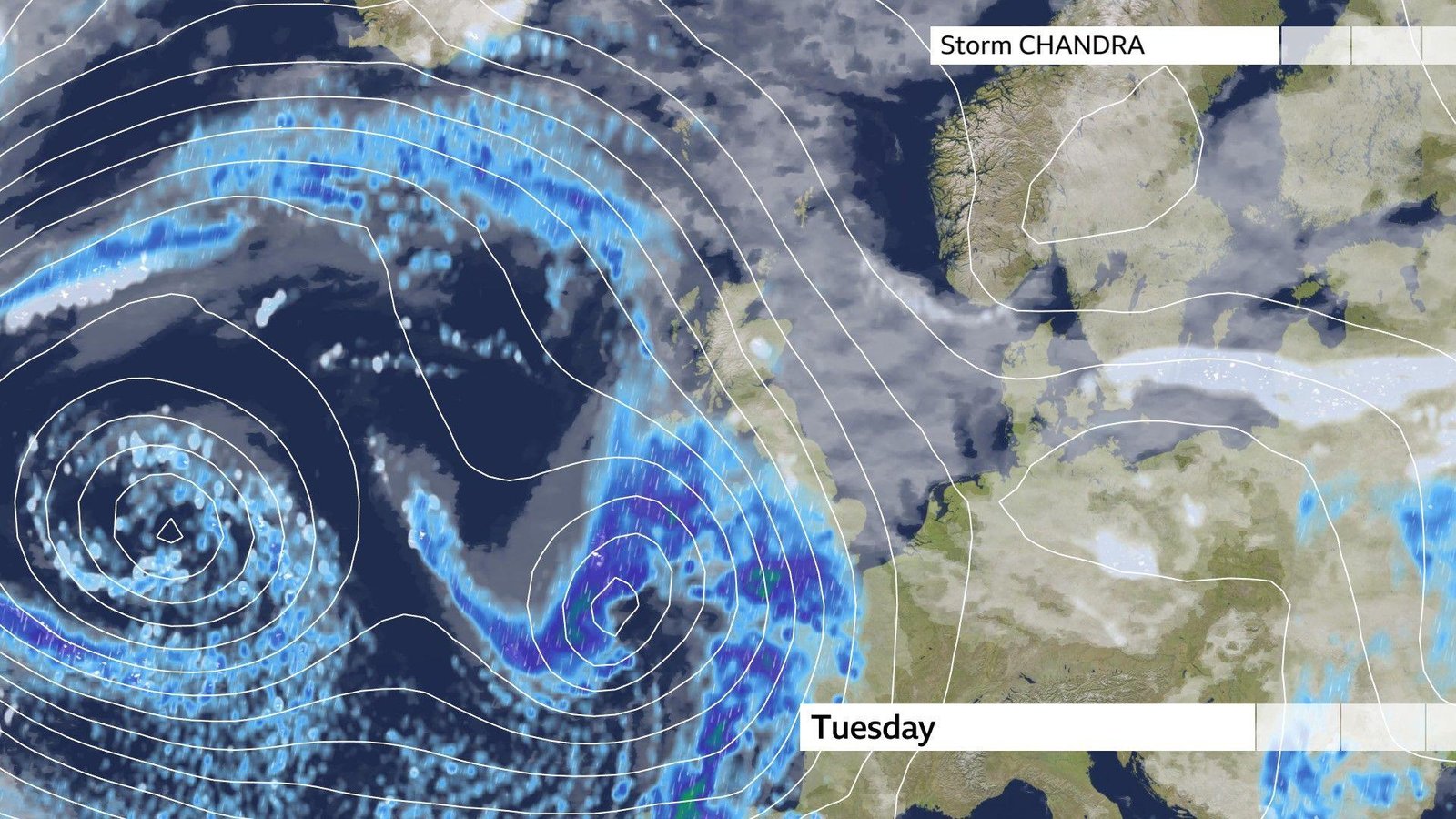

Storm Chandra swept across parts of the UK and Ireland on Tuesday, bringing heavy rain, strong winds and widespread disruption, with hundreds of schools closed, transport services hit, and flood rescues reported in multiple areas.
In the UK, the Met Office issued an amber wind warning for the eastern coast of Northern Ireland alongside several other warnings across the country. The weather agency said: “#StormChandra has been named and is forecast to bring strong winds and heavy rain to the UK on Tuesday,” in a post on X.
Northern Ireland was among the hardest hit for immediate disruption. More than 300 schools and higher education providers closed, while Belfast City and Belfast International airports cancelled dozens of flights. Ferry operator Stena Line also cancelled multiple sailings on routes including Belfast–Liverpool and Dublin–Holyhead due to “adverse weather.”
Flooding concerns were especially acute in south-west England. In Devon, the Environment Agency said the River Otter at Fenny Bridges reached its highest recorded level, surpassing the previous record from December 2000, with levels reported at 2.83m at 5.45am on Tuesday. The agency said: “Storm Chandra brought significant rainfall across Devon and Cornwall overnight, falling on already saturated ground.” It added that East Devon received 67mm of rain in 12 hours and 88mm was recorded at Whitebarrow on Dartmoor, with dozens of flood alerts and warnings active across the region and around 20 properties reported flooded at the time.
Emergency services carried out water rescues in the UK as conditions worsened. Firefighters in Devon and Somerset rescued people from 25 vehicles in flood water on Tuesday morning, according to the Devon + Somerset Fire + Rescue Service, which said there were no casualties.
In the Republic of Ireland, Storm Chandra triggered severe flooding and power outages overnight. Emergency services carried out multiple rescues in Dublin on Tuesday morning, where motorists were pulled from floodwaters. Forecasters cited about 30mm of rain falling in the capital overnight, while reports said around 30,000 people were without power and multiple roads were closed. Enniscorthy in County Wexford was among the worst affected after the River Slaney burst its banks.
Officials also warned of secondary hazards after the storm’s peak, including icy conditions. The Met Office issued a yellow-level warning for ice for all of Northern Ireland between 3am and 10am on Wednesday, and broader ice warnings for large parts of the UK, noting: “Patchy ice is likely to form on untreated surfaces by Wednesday morning and may lead to some disruption,” a Met Office spokesman said.