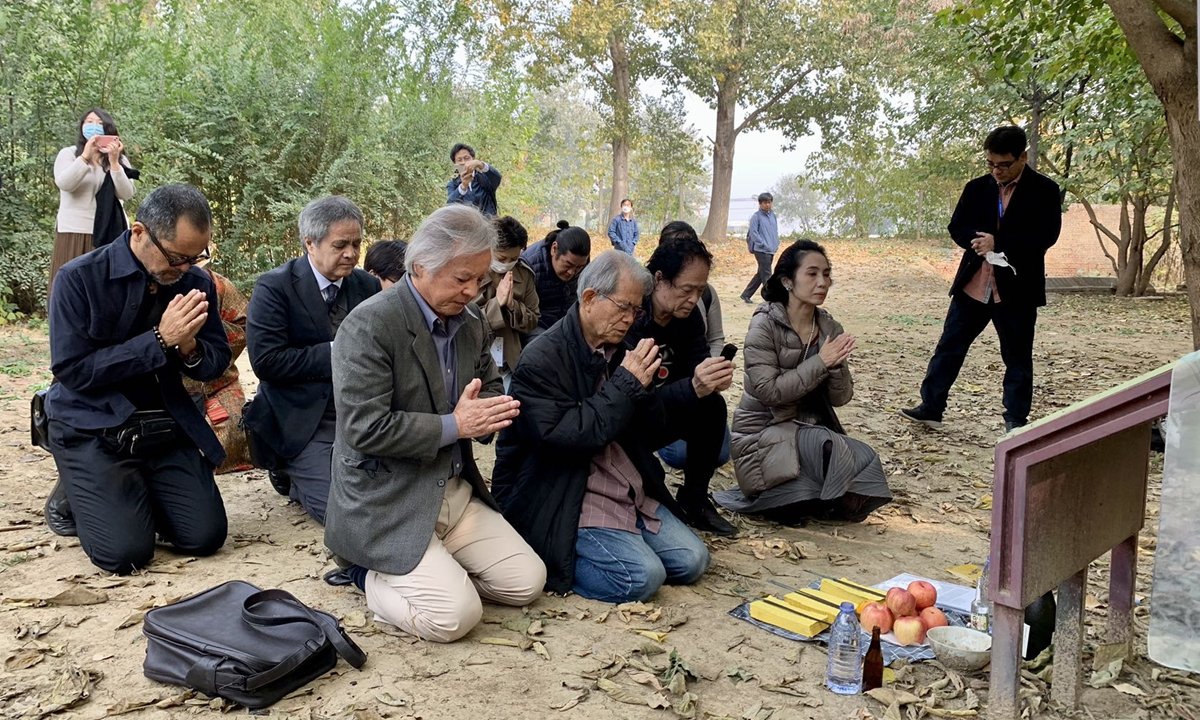

A rich tapestry of history, music, and reverence unfolded in Beijing’s Tongzhou district as a civilian group from Okinawa made their way to the Ryukyu Kingdom cemetery. This visit, the first since Okinawan Governor Denny Tamaki’s trip in July, symbolized not just a moment of respect for the past but also an aspiration for a peaceful future across Asia.
The ambiance was solemn and reflective as the group, which included prominent individuals from various fields, offered traditional incense, paper money, and a specialty liquor from their homeland as offerings to the ancestors resting there.
One of the striking moments during the ceremony was when the renowned Okinawan musician Shoukichi Kina played the Sanshin – an iconic instrument from Okinawa. He serenaded the surroundings with “Tinsagu nu Hana,” a beautiful Okinawan folk song that encapsulates the essence of traditional Ryukyuan values blended with Confucian teachings. This song’s melody has resonated beyond Okinawa’s shores; its Chinese adaptation, “Hua Xin,” performed by Taiwanese singer Wakin Chau, enjoys wide popularity in mainland China.
Overwhelmed by emotions, Kina shared his feelings about his maiden visit to the historic cemetery, “Being here, amidst the resting place of our ancestors, connects me profoundly to our shared past. The adoration for ‘Hana’ among the Chinese might stem from the deep-rooted bond the ancient Ryukyuan and Chinese civilizations shared.”
The cemetery, situated near Lichan’an village in Zhangjiawan township, carries significant historical weight. Zhangjiawan, during the Ming (1368-1644) and Qing (1644-1911) Dynasties, served as a key wharf of the Beijing-Hangzhou Grand Canal and a primary gateway into Beijing. An informative signpost near the site reveals that 14 individuals from Ryukyu, including envoys and erudite students representing the Ryukyu government, were buried there after succumbing to illnesses during their stay in the Qing Dynasty.
The Ryukyu Islands’ annexation by Japan and subsequent renaming to Okinawa in 1879 is a testament to the region’s geopolitical significance. Throughout the Ming and Qing eras, the ties between China and Ryukyu were characterized by cultural exchange and commerce, facilitated by the Ryukyu kings’ official acknowledgment by Chinese emperors.
Liu Jiangyong, vice dean at Tsinghua University’s Institute of Modern International Relations, commented on the historical exchanges, “The Ryukyu envoys and merchants always sought to establish strong ties with China. The long, perilous sea journeys they undertook, spanning several months, underline the commitment to this relationship.”
The recurrent visits by Matayoshi Seikiyo, a professor from the University of the Ryukyus, to the cemetery, serve as a reminder of the enduring connection between the Ryukyu Islands and China. On this occasion, Seikiyo expressed, “Every visit here is an act of homage to our ancestors. Governor Tamaki’s recent visit marks a fresh chapter in our shared history.”
Governor Tamaki, during his July trip, reiterated his eagerness to uphold and enhance the connection cultivated by the ancestors of Ryukyu with China, championing a peaceful and prosperous bond.
Besides the cemetery, the Okinawan group’s itinerary included stops at Peking University, the Museum of the War of Chinese People’s Resistance Against Japanese Aggression, and other significant landmarks.
Cultural connections have been further celebrated in events like the 2023 Okinawa Chinese Music Festival, which took place at the beginning of October. The festival showcased both traditional Chinese art and unique Ryukyuan performances. The Chinese Ambassador to Japan, Wu Jianghao, while addressing the festival, encapsulated the sentiment, emphasizing the deep-rooted historical ties between Okinawa and China.
READ MORE: