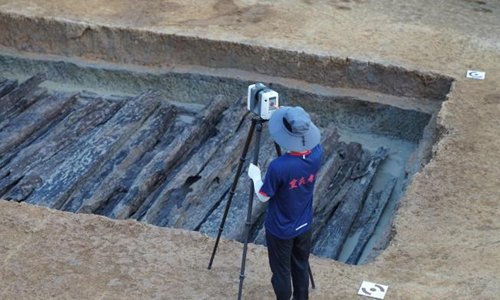

A remarkable archaeological discovery has been made in Southwest China’s Chongqing Municipality with the unearthing of ancient wooden slips, known as mudu. These artifacts are of significant historical value as they are the first to reveal insights into ancient Chinese celestial knowledge.
The find consists of 23 individual wooden slips, each inscribed with characters pertaining to the ancient Chinese astronomical calendar. This discovery is a milestone in understanding early Chinese documentation practices. Wooden slips, along with bamboo slips or jiandu, represent some of the earliest forms of written Chinese documents. They played a crucial role in the evolution of Chinese literature and were a predominant form of early Chinese books.
The characters inscribed on these slips relate to the Tiangan Dizhi, or the “Ten Heavenly Stems and 12 Earthly Branches.” This ancient system involved ten characters used as ordinals and another twelve used to divide the day into twelve two-hour periods. An example is the character ‘wu,’ representing the time from 11 am to 1 pm, indicating the sophistication of time-keeping and calendrical systems in ancient China.
These wooden slips were found in a tomb dating back to the Western Han Dynasty (206BC-AD25), a period renowned for its cultural and scientific advancements. Huang Wei, an associate researcher at the Chongqing Institute of Cultural Relics and Archaeology, noted that the calendar remains in remarkably good condition.
While the exact purpose of these slips remains a subject of speculation, archaeologist Wang Meng believes that they may have been bound together, possibly serving as a personal or professional tool for the tomb’s occupant. The presence of such an artifact in a tomb may reflect the occupant’s profession or beliefs.
Yu Pei’er, a Sichuan archaeologist, emphasized the unique nature of these slips, especially considering their astronomical contents. Their discovery in an ancient tomb provides new avenues for research into the burial customs and beliefs of the period.
The site of this discovery, the Guankou No.1 Western Han Tomb in Wulong district of Chongqing, has been dated to 193BC based on the inscriptions on the wooden slips. This makes it one of the oldest tombs from the Western Han Dynasty ever discovered. The tomb’s contents, including these slips, provide invaluable insights into the era’s burial practices and daily life.
In addition to the wooden slips, the tomb yielded an impressive collection of over 600 artifacts, including lacquerware, wood and bamboo wares, and bronze items. Notably, ancient accessories such as earrings and lacquer plates were found in exceptionally well-preserved conditions, adding to the significance of this find.
This discovery is a testament to the rich historical legacy of the Western Han Dynasty and offers a unique glimpse into the sophisticated astronomical knowledge and cultural practices of ancient China. The wooden slips not only enrich our understanding of early Chinese documentation and time-keeping systems but also open up new perspectives on the social and professional life of that era. As the first known example of an astronomical calendar inscribed on wooden slips, this find marks a significant contribution to the field of archaeology and the study of ancient Chinese civilization.
READ MORE: