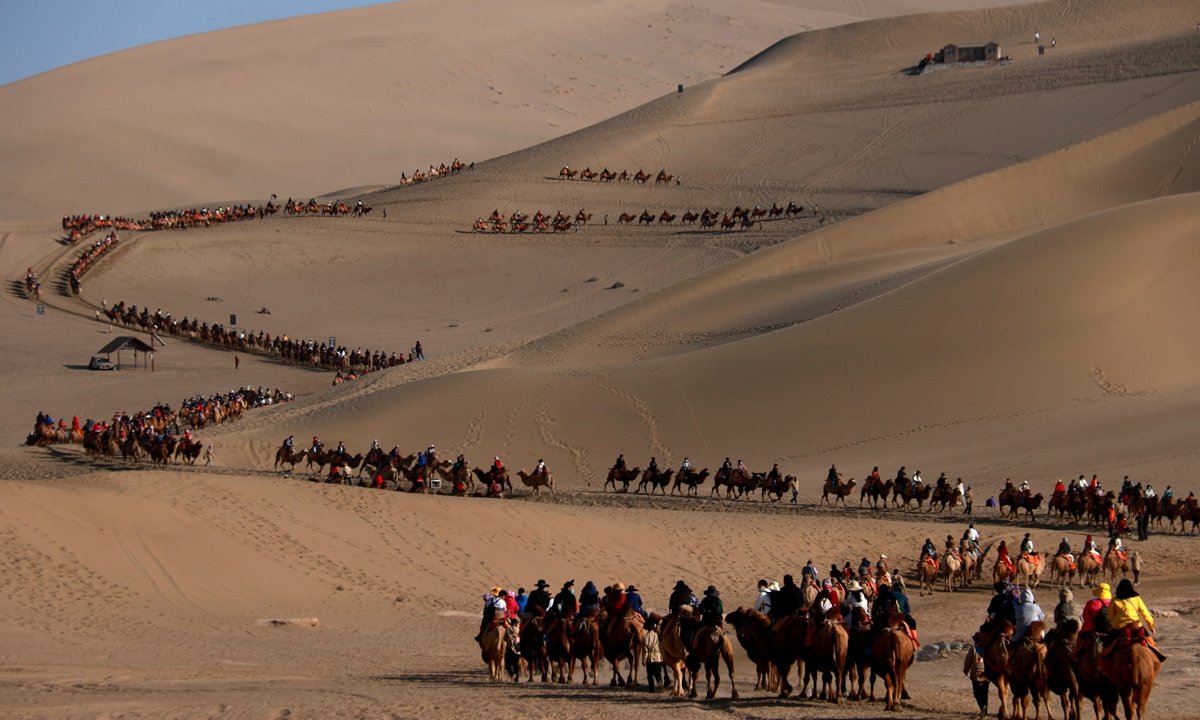

Chinese archaeologists have made a groundbreaking discovery in Dunhuang, Gansu Province, uncovering evidence of ‘mixed-race’ individuals who lived during the Wei (220-265) to Tang (618-907) dynasties. This finding sheds new light on the diverse cultural interactions that took place along the ancient Silk Road, a historic trade route that connected East and West.
Dunhuang, strategically located in the Hexi Corridor, was a key city on the Silk Road, facilitating trade and cultural exchange between civilizations. In a significant first, archaeologists obtained 25 ancient genomic data samples from this region, revealing extensive population migrations and intermingling.
Two individuals from the Wei period and Tang Dynasty, in particular, were identified as having multi-ethnic ancestry. Their genetic makeup indicates a mix of East and West Eurasian ancestry, with 30 to 50 percent of their genetic components originating from Western Eurasia. This suggests a historical blending of local Dunhuang males with females from the western regions, known as ‘Huji’ during the Tang Dynasty.
Associate Professor Wen Shaoqing from Fudan University’s Institute for Archaeological Science explained that the distinctive mixture in these individuals indicates they were descendants of local Dunhuang men and foreign women. This theory is further supported by murals in Dunhuang that depict a diverse range of ethnicities.
The presence of multi-ethnic individuals in Dunhuang provides concrete evidence of the Silk Road’s role as a melting pot of cultures and ethnicities. The Hexi Corridor, a crucial junction for East-West cultural exchange, has long intrigued historians, but the absence of ancient DNA left a gap in understanding the population history of the region. The latest archaeological advancements have bridged this gap, uncovering two major episodes of population migration and integration over the past two millennia.
Through the analysis of ancient genomes, researchers have reconstructed the genetic history of the Hexi Corridor’s inhabitants, adding context to the rich historical narratives and poetry from the Tang Dynasty, including works by the celebrated poet Li Bai.
This collaborative research, involving Fudan University’s Institute for Archaeological Science, School of Life Sciences, Xiamen University, and the Gansu Provincial Institute of Cultural Relics and Archaeology, has been published in the Science Bulletin journal. The findings not only highlight the historical significance of Dunhuang but also underscore the Silk Road’s legacy as a corridor of multicultural coexistence and interaction.
READ MORE: