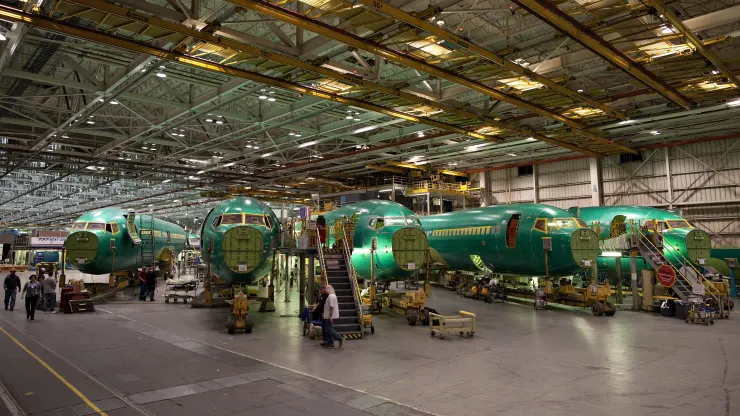

Boeing announced on Monday its plans to acquire fuselage manufacturer Spirit AeroSystems in an all-stock transaction valued at $8.3 billion, including Spirit’s debt. The purchase price is set at $37.25 per share in Boeing stock, giving Spirit an equity value of $4.7 billion. This deal follows recent challenges faced by Boeing, including a midair fuselage panel blowout on a 737 Max 9 aircraft in March.
Spirit AeroSystems, based in Wichita, Kansas, has been a key supplier for Boeing, manufacturing fuselages for the 737 and other components for Boeing’s 787 Dreamliners. Originally part of Boeing, Spirit was spun off in 2005. Last year, Boeing accounted for approximately 70% of Spirit’s revenue, while around 25% came from producing parts for Airbus.
Boeing CEO Dave Calhoun emphasized that this acquisition will “fully align” the production systems and workforces of the two companies, strengthening quality and reinforcing Boeing’s commitment to safety. The transaction is expected to close by mid-2025, pending regulatory and shareholder approvals and the sale of Spirit’s Airbus-related operations.
Spirit AeroSystems’ CEO, Pat Shanahan, is seen as a potential successor to Calhoun, who plans to step down at the end of the year. Meanwhile, Airbus has secured a deal with Spirit, receiving $559 million in compensation and acquiring Spirit’s manufacturing lines dedicated to Airbus planes for $1. These operations include facilities in Belfast, Wichita, and North Carolina.
The acquisition comes amid Boeing’s ongoing efforts to address production issues and safety concerns, including those highlighted by a National Transportation Safety Board preliminary report on the Alaska Airlines incident. The report indicated that the bolts securing a door plug were not attached when the aircraft was delivered. This incident, among other production challenges, has delayed Boeing’s plane deliveries and impacted both Boeing and Spirit financially.
U.S. prosecutors are expected to charge Boeing with conspiracy fraud related to the development of its 737 Max planes, which were involved in two fatal crashes in 2018 and 2019. The Justice Department had previously claimed Boeing violated a 2021 settlement that protected it from prosecution.
The Federal Aviation Administration (FAA) has stated that Boeing must satisfy production standards before it can expand production. This acquisition is part of Boeing’s broader strategy to improve quality control and production efficiency, aiming to prevent future defects and ensure seamless manufacturing processes.
Despite these challenges, Boeing is moving forward with this acquisition to bolster its capabilities and maintain its commitment to safety and quality in aircraft manufacturing.
READ MORE: