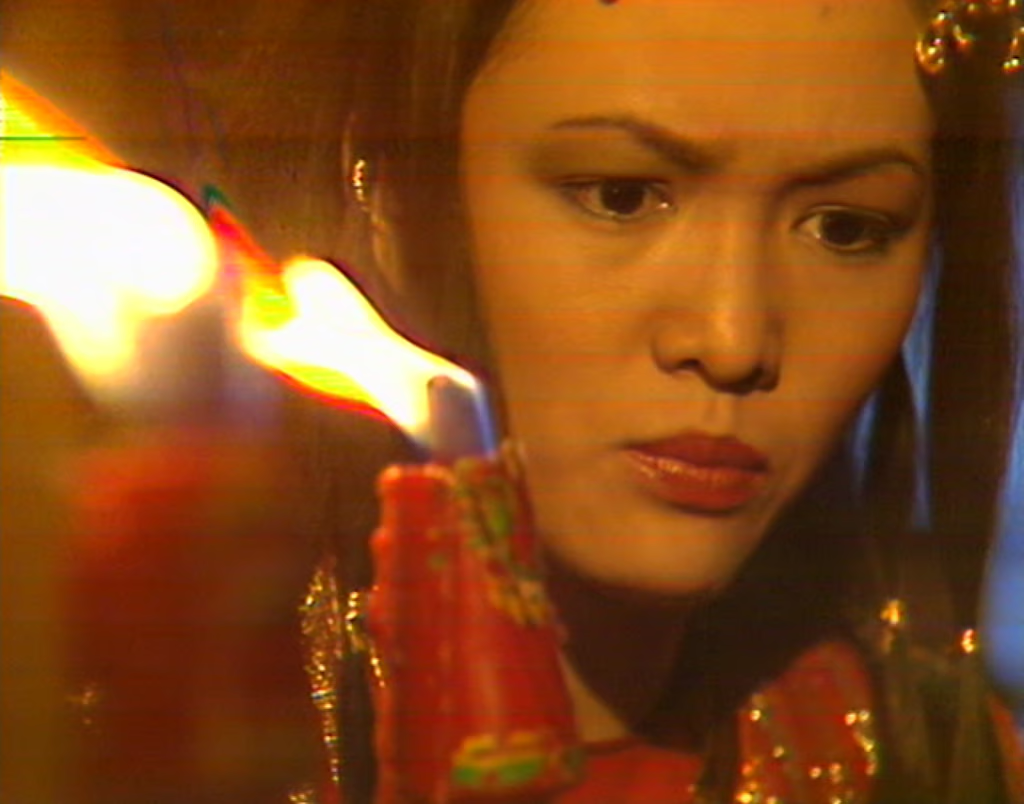

On July 2, 1978, Hong Kong television made history with the debut of The Gold Dagger Romance, a martial arts series unlike any other. Created by screenwriter-director Tsui Hark, the series aired on Commercial Television (CTV) and immediately set itself apart from the typical productions on other Hong Kong networks like TVB and RTV. Based on Gu Long’s novel Eagle Soaring in the Ninth Month, the show was marked by a departure from traditional martial arts storytelling, avoiding melodramatic dialogue and opting instead for a hauntingly silent opening sequence, underscored only by striking imagery.
The show’s initial moments introduce viewers to a solitary swordsman on a snow-covered landscape, observed by assassins who eventually defeat him, symbolized by his umbrella drifting away in silence. This intense, almost poetic start was a clear signal of Tsui’s distinct storytelling approach. Having studied film at the University of Texas, Tsui brought a fresh, American-influenced cinematic perspective to Hong Kong television, crafting a series with an aesthetic emphasis on unique camera angles and dynamic editing. The Gold Dagger Romance not only honored its source material’s philosophical depth but also introduced a new standard for Hong Kong television.
The six-episode series follows swordsman Yip Hoi (played by Yu Tien-lung) and his lover Ting Ling-ling (portrayed by Carol “Dodo” Cheng Yu-ling) as they battle a cult led by the enigmatic Sheung-kwun Siu-sin (Candice Yu On-on). Tsui’s inventive direction includes scenes like Yip Hoi’s hypnotic encounter with four masked women, which he filmed with intense close-ups and eerie electronic music, transforming Gu Long’s writing into an even more foreboding experience. The series was shot on location in Korea, where Tsui’s use of snowy landscapes and contrasting chiaroscuro lighting created an atmospheric tension rarely seen on television.
Despite its groundbreaking style, The Gold Dagger Romance struggled to achieve its intended goal. While CTV hoped the series would boost its standing in Hong Kong’s TV landscape, financial strain ultimately led the station to close in August 1978. Yet, Tsui’s work on the show paved the way for a new wave of Hong Kong cinema. Just a year later, Tsui released his first feature, The Butterfly Murders, further developing his genre-blending style.
The impact of The Gold Dagger Romance is often associated with the beginning of the Hong Kong New Wave, an influential movement that redefined the region’s film industry. Filmmakers like Ann Hui and Alex Cheung brought similarly innovative perspectives to genres like murder mysteries and police dramas. Although the precise start of the New Wave is still debated, many look back to that July night in 1978 as the beginning of a new cinematic era in Hong Kong.
READ MORE: