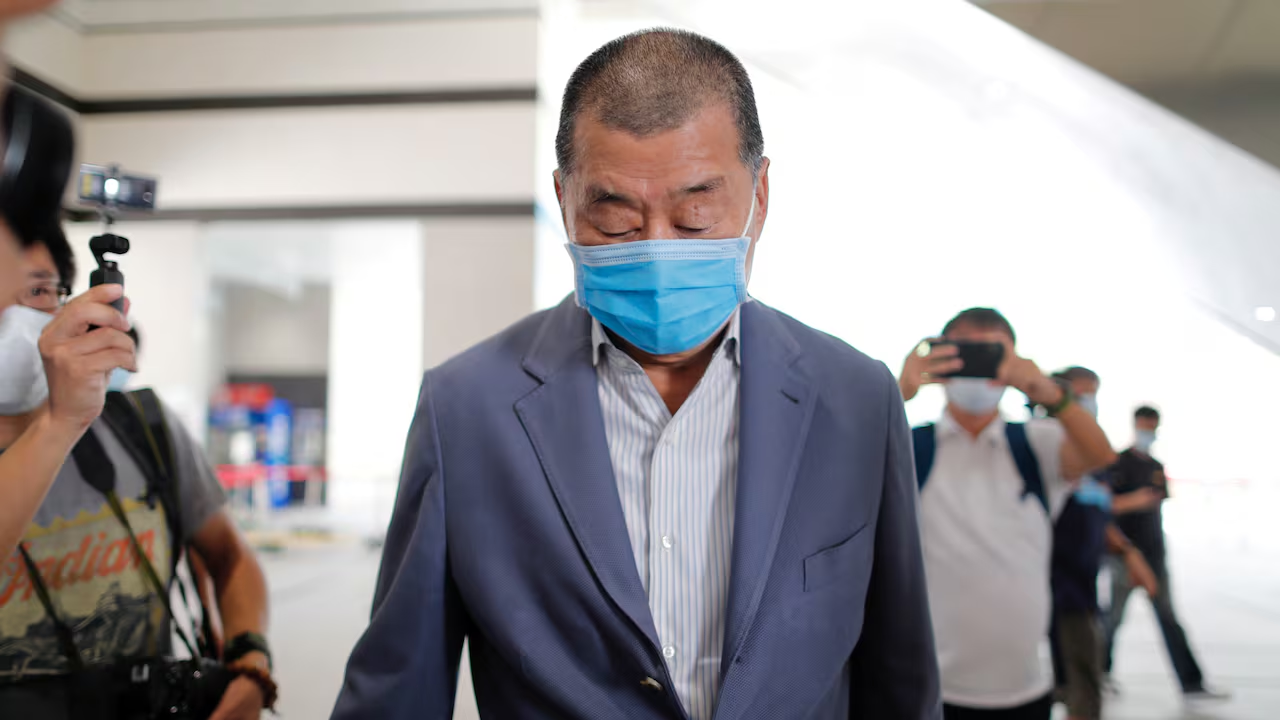

Hong Kong media tycoon Jimmy Lai has been sentenced to 20 years in prison, marking the longest sentence handed down under the city’s national security law. The 78-year-old, a prominent critic of Beijing, was convicted of collusion with foreign forces and sedition. The verdict has drawn international condemnation and renewed concerns over press freedom in the semi-autonomous territory.
Jimmy Lai, a self-made billionaire and founder of the pro-democracy newspaper Apple Daily, has been sentenced to two decades in prison. This landmark ruling concludes a protracted legal battle that has become emblematic of Beijing’s crackdown on dissent in Hong Kong since the imposition of the national security law in 2020. Lai, aged 78, was found guilty of charges including conspiracy to collude with foreign forces and conspiracy to publish seditious materials.
The sentence has ignited widespread international outcry. Western governments, including the United States and the United Kingdom, have decried the verdict as politically motivated and a blow to press freedom. Lai’s son, Sebastien, called the sentence “draconian” and “life-threatening,” while his daughter, Claire, described it as “heartbreakingly cruel,” fearing her father would “die a martyr behind bars.”
Authorities in Beijing and Hong Kong have defended the prosecution, asserting that Lai used Apple Daily to undermine national security and incite hatred. Hong Kong’s leader, John Lee, stated that Lai’s sentence demonstrated the rule of law and brought “great satisfaction to the people.” The national security law has significantly altered Hong Kong’s political landscape, leading to the disbandment of civil society groups and media outlets, and the jailing of numerous dissidents.
Judges found that Lai had “harbored his resentment and hatred of the PRC” and labeled him a “mastermind of the conspiracies.” Evidence presented included his lobbying of U.S. politicians and his newspaper’s calls for international sanctions against China and Hong Kong. Lai’s defense argued that his health had deteriorated significantly during his more than five years in detention, including solitary confinement. However, the court stated it was not inclined to reduce his sentence based on his medical condition.
Alongside Lai, six former Apple Daily colleagues and two activists were also sentenced. Their prison terms range from approximately six years and nine months to 10 years. Some of these co-defendants provided evidence for the prosecution, which contributed to reduced sentences.
Lai’s conviction and sentencing are seen as a culmination of Beijing’s efforts to silence opposition in Hong Kong. The city’s press freedom ranking has plummeted in recent years. Experts suggest that the broad interpretation of national security laws could have chilling effects on journalistic activities and the free exchange of ideas, potentially impacting Hong Kong’s status as a global financial hub.