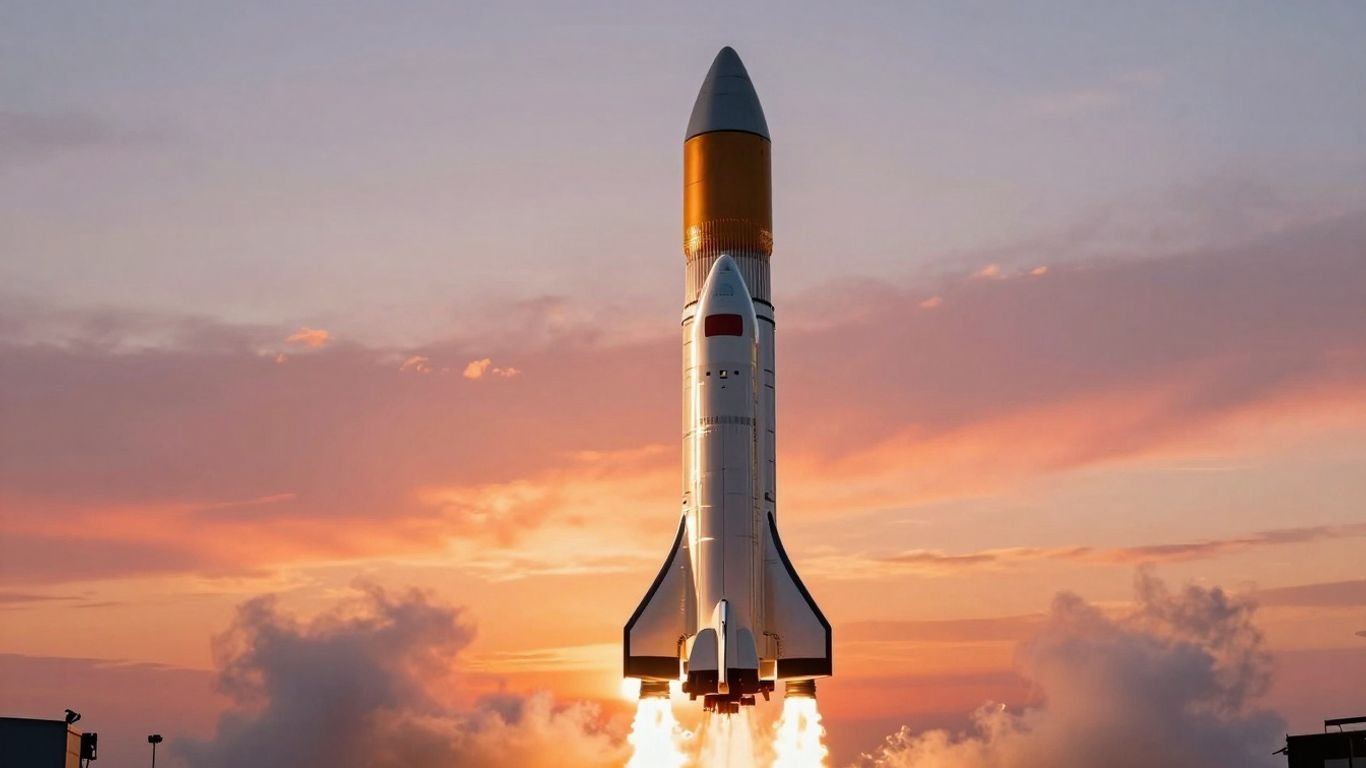

Chinese launch startup iSpace has announced a significant Series D+ funding round of $98 million, bolstering its development of the reusable Hyperbola-3 rocket. This infusion of capital comes as several commercial competitors in China are making strides with hot fire tests, intensifying the nation’s race towards reusable launch capabilities.
iSpace’s Funding Boost and Hyperbola-3 Development
The latest funding for iSpace, also known as Beijing Interstellar Glory Space Technology Ltd., was led by Chengdu Advanced Capital and supported by other Chengdu-based investment funds. This investment will fuel the development of the Hyperbola-3, a two-stage, methane-liquid oxygen rocket designed for reusability. The funds will also support the construction of a rocket production base in Chengdu and an engine production line in Mianyang.
The Hyperbola-3 stands at 69 meters tall and is designed to carry 8,500 kilograms to low Earth orbit in reusable mode. While an inaugural flight was initially targeted for December, iSpace is now focused on pre-maiden flight preparations, with all components for the first rocket reportedly delivered and final assembly underway. The company has also developed China’s first autonomous rocket recovery ship, “Xingji Guihang,” in preparation for an “orbital plus offshore recovery” test flight from the Hainan commercial space launch center.
Competitors Accelerate Reusable Rocket Tests
The commercial space landscape in China is buzzing with activity. Space Pioneer recently conducted a successful static fire test of the first stage for its Tianlong-3 kerosene-liquid oxygen rocket. This test follows a previous setback and utilized nine Tianhuo-12 engines fired in parallel on an offshore platform.
Other companies are also reporting progress. Orienspace performed a full hot fire test of its Force-110 engine for the Gravity-2 vehicle and aims for a test flight by year-end. Deep Blue Aerospace successfully tested its Thunder RS engine, which will power the larger Nebula-2 rocket, with an orbital launch targeted for 2026.
These companies, alongside others like Landspace with its Zhuque-3, are in a race to achieve orbital launches, demonstrate recovery and reusability, and secure contracts for significant projects such as the national Guowang broadband megaconstellation. The rapid advancements and significant investments highlight the increasing maturity and competitiveness of China’s private space sector.