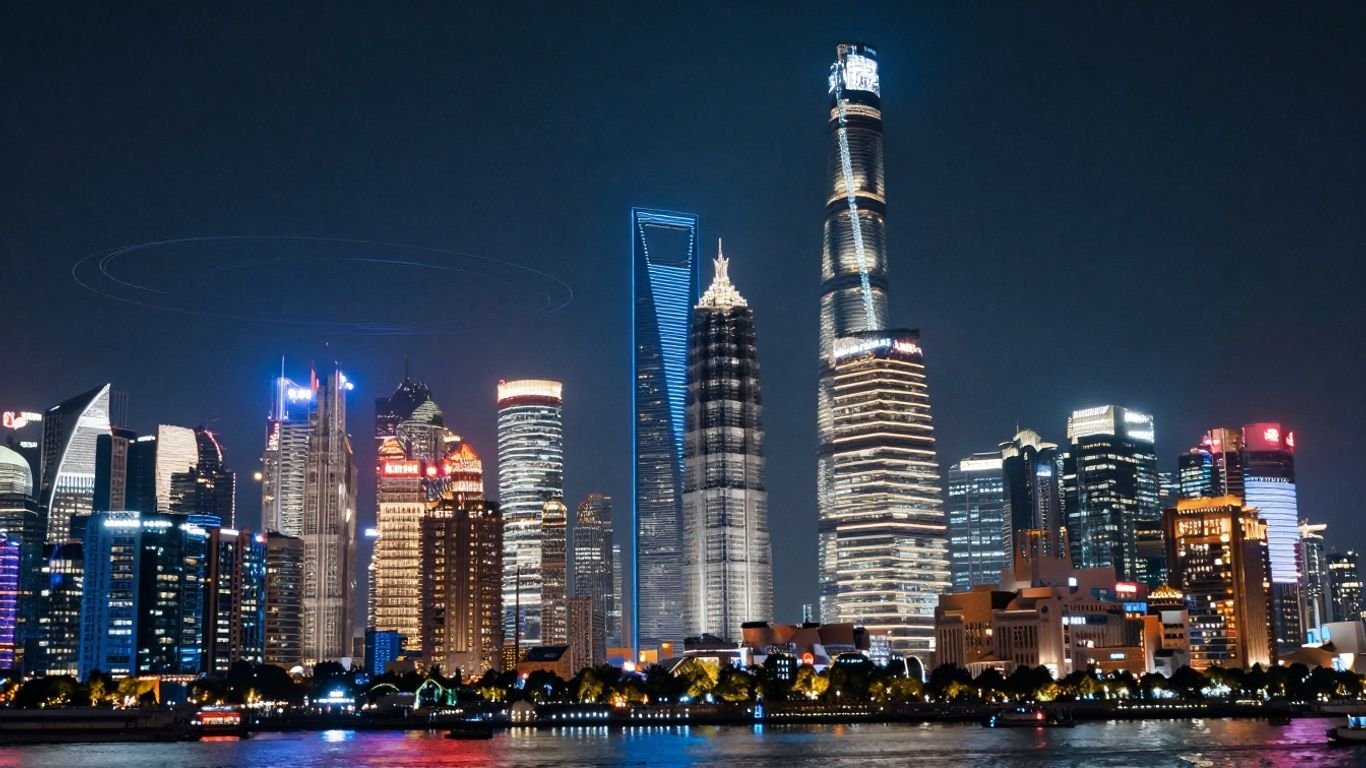

Shanghai has announced a significant investment of over $10 billion (70 billion yuan) to bolster its high-tech industries, including artificial intelligence, semiconductors, and aviation. This move by the Pudong district, involving 50 major projects, signals China’s intensified strategy to achieve technological self-sufficiency and compete directly with the United States on the global stage.
A Strategic Push for Technological Supremacy
Shanghai’s substantial investment is a direct response to the escalating tech race with the United States. The initiative aims to accelerate China’s progress in critical technologies where US export controls have previously posed challenges. This city-by-city approach, with Shanghai at the forefront, reflects Beijing’s strategy of empowering regional hubs to drive innovation and reduce reliance on foreign technology.
Ambitious Goals for Key Industries
The investment is earmarked for several strategic sectors. Pudong has set aggressive targets, aiming for its chip industry to achieve an annual economic output exceeding 500 billion yuan by 2030. Similarly, the AI and aircraft manufacturing sectors are targeted to reach outputs of over 200 billion yuan and 100 billion yuan, respectively. These goals are supported by Shanghai’s existing strengths, including the presence of major tech players like Semiconductor Manufacturing International Corporation (SMIC) and AI giant SenseTime.
Government Backing and Ecosystem Advantages
Shanghai’s party chief, Chen Jining, has pledged full government backing for local AI startups, promising tailored policies to support their rapid growth. This proactive government involvement is seen as a key advantage in China’s approach to industrial policy. Furthermore, Shanghai’s established status as a financial and trade center, coupled with a comprehensive manufacturing chain, provides a robust ecosystem for quickly bringing new technologies into production. This advantage is particularly noted when compared to many US cities and even other Chinese urban centers.
Broader National Strategy and Future Outlook
Shanghai’s tech offensive is part of a larger national effort, with other major cities like Shenzhen also implementing similar initiatives. This coordinated mobilization suggests a distributed execution strategy by Beijing to win the technology competition. While questions remain about the efficiency of government-directed resource allocation, Shanghai’s significant GDP and financial capacity provide the firepower to sustain these long-term technology investments. The success of this ambitious plan will be a critical test in the intensifying US-China technology rivalry.