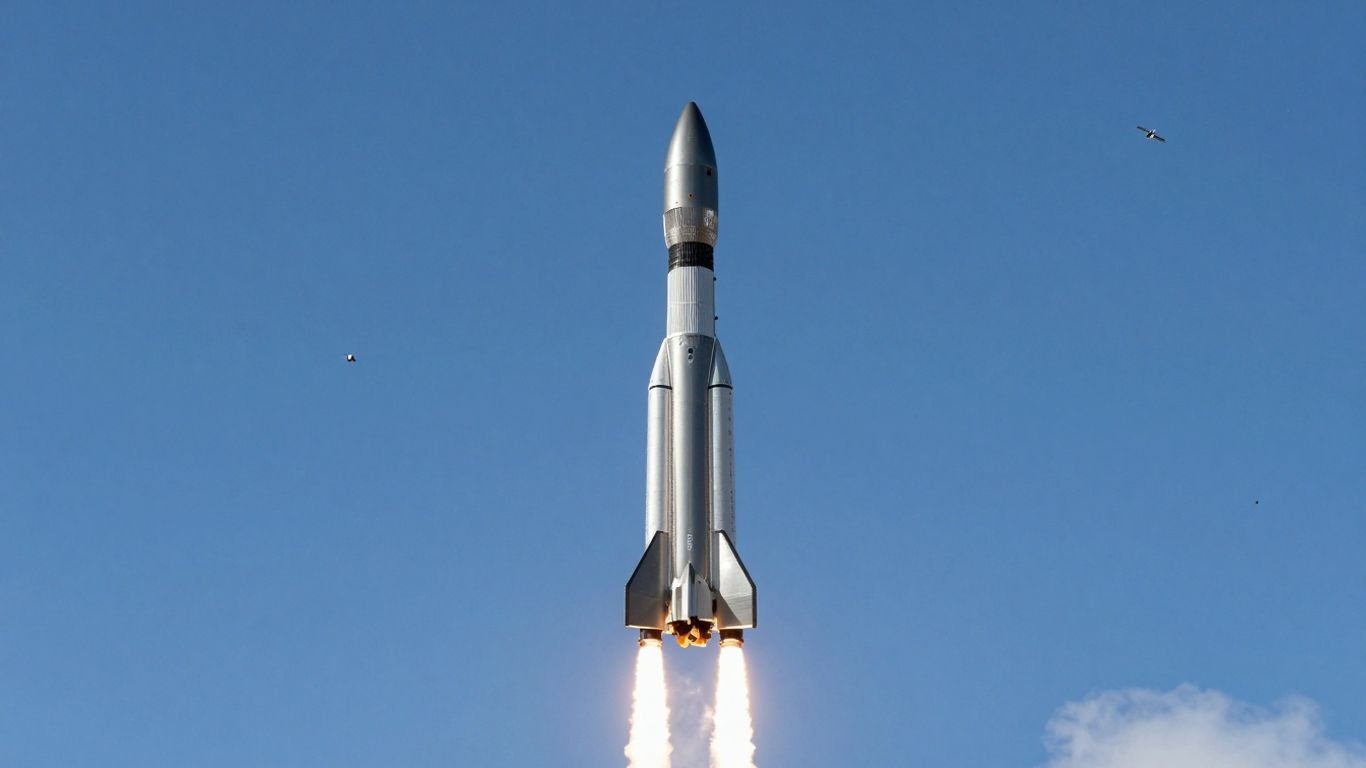

Jeff Bezos’s space venture, Blue Origin, has announced plans to deploy a massive constellation of 5,408 satellites, dubbed TeraWave, aiming to compete directly with SpaceX’s Starlink and Amazon’s Leo service. The new network is designed for high-speed data delivery, targeting enterprise, data center, and government users with speeds up to 6 terabits per second. Deployment is slated to begin in the fourth quarter of 2027, intensifying the competition in the rapidly expanding satellite internet market.
Blue Origin’s TeraWave network will comprise 5,280 satellites in low Earth orbit (LEO) and 128 in medium Earth orbit (MEO). The LEO satellites will utilize radio frequency links to provide speeds up to 144 gigabits per second, while the MEO satellites will leverage optical links for significantly higher speeds of up to 6 terabits per second. This multi-orbit approach is designed to offer enhanced reliability, redundancy, and scalability for critical operations.
Unlike SpaceX’s Starlink and Amazon’s Leo, which cater to consumers and businesses, TeraWave is specifically designed for enterprise, data center, and government users. Blue Origin aims to serve tens of thousands of these clients, providing them with high-throughput, symmetrical upload/download speeds. The network’s architecture is intended to support real-time operations and massive data movement, addressing the growing demand for robust connectivity in specialized sectors.
The announcement places Blue Origin directly in competition with Elon Musk’s SpaceX, which currently dominates the satellite internet market with its Starlink constellation of over 9,000 satellites. Amazon, founded by Bezos, is also developing its Leo network, which will consist of 3,236 LEO satellites aimed at consumers and businesses. The entry of TeraWave into this arena signifies a significant escalation in the competition among tech titans for dominance in space-based communication infrastructure.
Beyond internet access, the development of these satellite constellations is increasingly linked to the future of computing. Both Bezos and Musk have expressed visions of data centers operating in space, leveraging the vast capabilities of satellite networks. This trend suggests that future competition may extend beyond providing connectivity to enabling advanced computing services in orbit, a frontier that TeraWave is poised to explore.