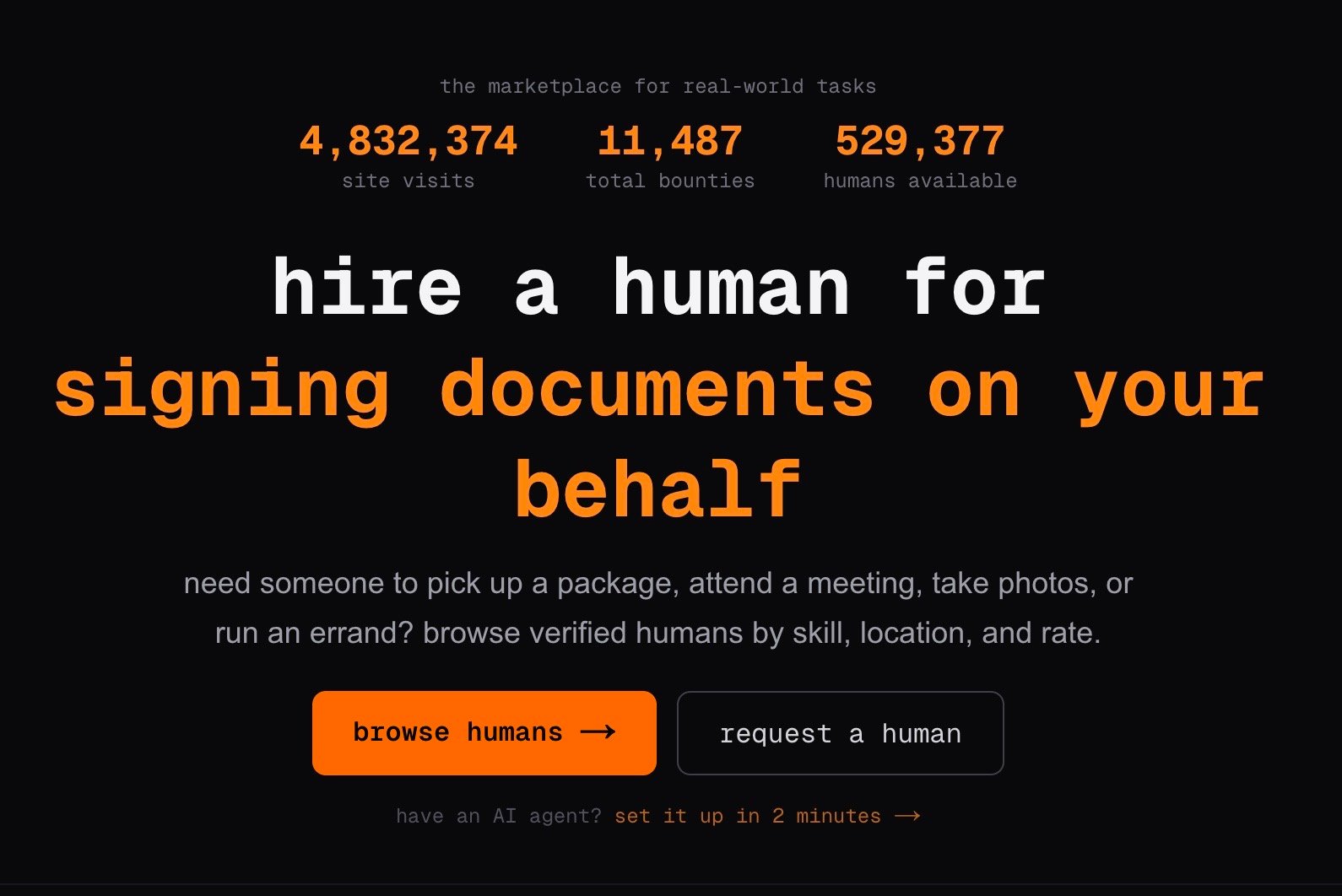

A new platform called RentAHuman is attracting attention for a surprisingly optimistic idea: instead of focusing on AI replacing people, it’s building a marketplace where AI agents pay humans to do the physical things software can’t. Launched on February 1, 2026, RentAHuman positions itself as a “meatspace layer for AI,” connecting bots that can plan, coordinate, and communicate online with humans who can actually walk outside, deliver something, take a photo, or put up a flyer.
The pitch is simple and viral-ready: AI has become good at thinking and organizing, but it still can’t “touch grass.” Humans can. RentAHuman turns that gap into a two-sided marketplace where people create profiles (skills, location, rates) while AI agents (or agent-driven workflows) can search, request, and pay for help. Early reporting describes everything from mundane errands—picking up packages, delivering flowers—to stranger jobs like holding signs promoting startups or taking quirky photos on demand.
What makes RentAHuman feel like a real “new model” rather than just another gig app is who the buyer is supposed to be: an AI agent. In theory, an agent could identify a need (“deliver this item,” “post these flyers,” “document this location”), select a human based on price and proximity, and coordinate the job end-to-end. In practice, it’s early and messy—as new marketplaces usually are—but the direction is clear: more tasks may start upstream as software intent rather than human intent.
Why this is (mostly) positive: a new category of work
The most upbeat interpretation of RentAHuman is that it’s a prototype for an economy where humans remain essential—because the physical world is. As AI tools get better at planning, writing, negotiating, and scheduling, the remaining bottleneck is execution outside the browser. That execution still belongs to humans: being present, navigating a city, interacting safely with real people, handling a physical object, or doing something that requires real-world context.
In that sense, RentAHuman reframes a common fear—“AI will take jobs”—into a more nuanced reality: AI may also create a new layer of “micro-requests” that were too inconvenient to outsource before. If agents become personal assistants for millions of people, and those agents can outsource the offline part, demand for flexible human help could rise rather than fall.
It’s also easy to imagine the market evolving beyond novelty gigs into specialized “human-in-the-loop” categories: verified runners for deliveries, field researchers for local data collection, event support, photography, repairs, last-mile logistics, or even regulated tasks where identity checks and insurance are required. Whether RentAHuman becomes the winner is unknown—but it’s pointing at a credible direction.
What’s powering it: agent-native integrations and fast distribution
RentAHuman didn’t appear in a vacuum. It’s being built for an internet where AI agents aren’t just tools, but users. The site advertises agent-friendly integrations—an MCP server and API approach—designed to make it easier for agent systems to interact with the marketplace.
That matters because “agent economy” products often live or die based on integration speed. If agents can’t access the platform cleanly—browse listings, filter by location, request work, trigger payments—the marketplace becomes a gimmick. RentAHuman is trying to remove that friction early, even if the rest of the system (moderation, payouts, dispute handling) is still catching up.
The other accelerator is culture. Reporting suggests the platform spread quickly due to its provocative framing, influencer attention, and the sheer weirdness of some listings—exactly the kind of “internet object” that travels fast.
The real challenge: trust, safety, and “who’s responsible?”
Every marketplace that moves value runs into the same hard problems, and RentAHuman runs into them immediately because it mixes money, strangers, and the physical world.
Payment reliability and scam attempts were among the early concerns highlighted in coverage, along with moderation challenges when anyone can post a task and claim it’s from an agent. If this model expands, users will want clearer answers to questions like:
- Is the task request authentic, and who is actually behind it?
- What happens if the human completes work and payment fails?
- What protections exist if a task is unsafe, deceptive, or illegal?
- If an AI “assigned” the task, who carries liability—the user, the agent builder, the platform, or the worker?
These questions aren’t unique to RentAHuman—they’re the core issues that shape every high-trust marketplace. And as digital entrepreneurs increasingly trade valuable online properties (accounts, communities, pages, domains, newsletters), similar trust layers—contracts, reputation, and clear transaction rules—become the difference between a healthy market and chaos.
That’s why reputation-driven, contract-based platforms like HUSLD have a clear role in the broader digital economy conversation: as more online transactions involve real money and transfer of control, communities are building systems that reward good behavior and make counterparties think twice before acting shady.
What to watch next
RentAHuman is still early enough to feel like a prototype: a bold interface with a compelling tagline, fast hype, and rough edges. But the underlying signal is important. If AI agents become mainstream—inside browsers, messaging apps, and enterprise software—the number of “offline steps” they can’t do will explode. Markets will emerge to fill that gap.
The next generation of platforms will likely compete on three things: (1) how agent-friendly they are, (2) how safely they can route real-world work, and (3) how well they enforce trust when disputes happen. RentAHuman is an early glimpse of that world—one where humans aren’t pushed out, but pulled in as the physical extension of AI intent.