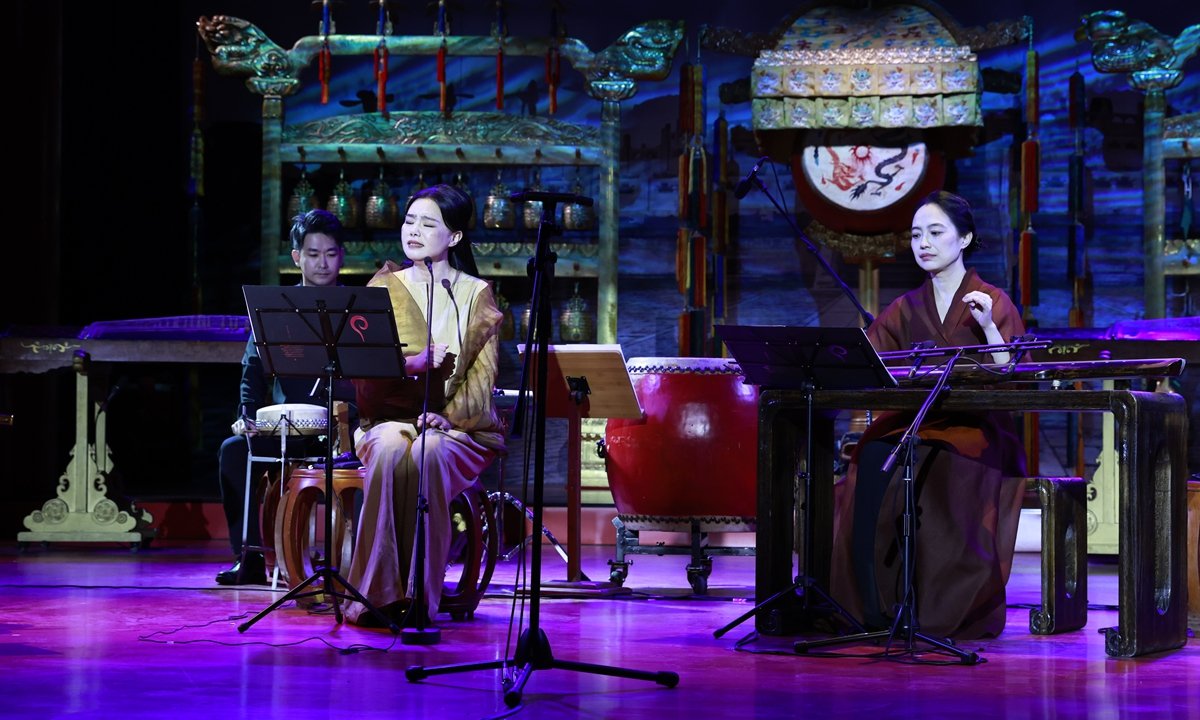

In the venerable precincts of Beijing’s Temple of Heaven, where the historic echos of the Divine Music Administration still linger, an ethereal blend of ancient melody and contemporary interpretation unfurled, unfolding an entrancing narrative of pain, longing, and timeless artistry, all woven into the nearly 1,800-year-old music piece, “Eighteen Songs of a Nomad Flute,” originating from the esteemed Han Dynasty poet, Cai Wenji.
Nestled within the cultural and historical richness of the Divine Music Administration, a place which during the Ming (1368-1644) and Qing (1644-1911) dynasties was the cradle for teaching “zhonghe shaoyue,” or simply “yayue” – ceremonial music specifically crafted for the imperial Chinese rituals of mourning and accession – the unfolding musical narrative brought audiences into an immersive experience that was both a temporal journey and an exploration of emotive landscapes.
Cai Wenji’s poignant life, peppered with both the aristocratic echoes of the Han Dynasty and the rustling winds of the nomadic Xiongnu plains, is elegantly and intricately expressed through the music piece. Her legendary life story, wherein she becomes a hostage to the Xiongnu nomads, experiences motherhood through the birth of two sons with their Wise King of the Left, Zuoxianwang, and subsequently returns to her homeland, forsaking her children in the nomadic lands, unfolds not merely as a historical recounting but as a symphonic tale entwining grief, sacrifice, and boundless love.
Gong Lina, a proficient musician who has breathed life into “qinge” or “guqin songs” for over a decade, seeing them as a vital fragment of literati music, embraced the stage, turning it into a portal through which audiences were drawn into the nomadic expanses where Cai Wenji once found both captivity and unexpected kinship. For Gong, releasing the “Eighteen Songs of a Nomad Flute” was not an impulsive endeavor. Rather, it was an aspiration cradled within her for years, waiting patiently for the opportune moment to release it into the world.
In collaboration with fellow musicians Lin Chen, Wang Hua, Nie Yunle, and Li Shang, Gong’s vision was brought to fruition, not merely as an album but as a live performance, where the spectral presence of Cai Wenji might have lingered among the audience, witnessing the timeless traverse of her emotions and experiences through the veils of time.
As the melodies flowed within the hallowed spaces of the Temple of Heaven, each note was not just a musical expression but a whisper from the past, carrying with it stories of love, loss, and unyielding spirit, gifting the audience not merely a performance but an ephemeral connection to the delicate threads that weave history, art, and shared humanity into a timeless tapestry.
READ MORE: