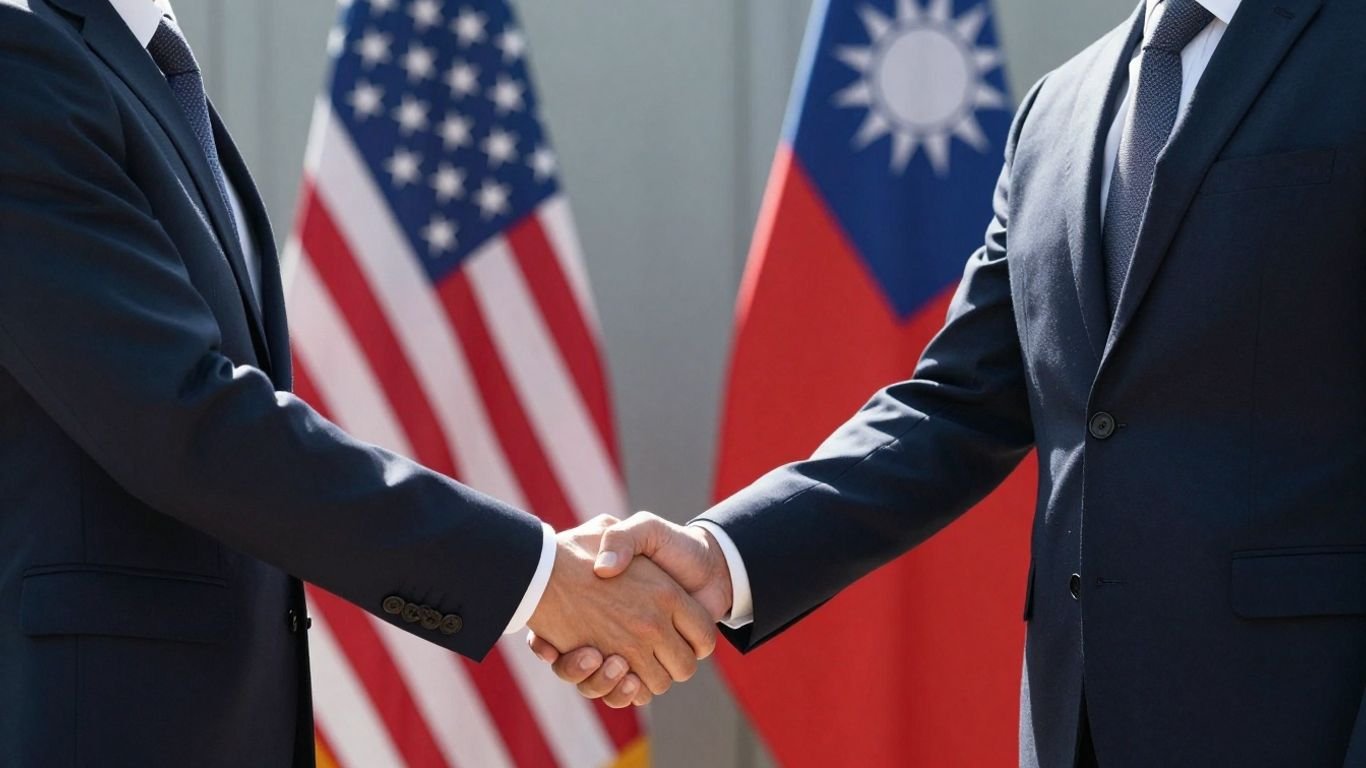

The United States and Taiwan have finalized a significant trade agreement aimed at reducing tariffs on Taiwanese exports and substantially increasing purchases of U.S. goods. This landmark deal is set to reshape bilateral trade dynamics, fostering closer economic ties between the two nations.
The newly signed agreement establishes a reciprocal trade framework where the U.S. will cap tariffs on Taiwanese imports at 15%. This move places Taiwan on par with other major U.S. trading partners in the Asia-Pacific region, such as Japan and South Korea. In return, Taiwan has committed to removing or reducing 99% of its tariff barriers on U.S. industrial and agricultural exports. This includes preferential market access for American goods like automobiles, beef, and minerals.
A significant component of the deal involves Taiwan’s commitment to purchase over $84 billion in U.S. goods from 2025 to 2029. These purchases are expected to include liquefied natural gas, crude oil, aircraft, and power equipment. The agreement also addresses long-standing non-tariff barriers, such as Taiwan’s acceptance of U.S. vehicles built to U.S. Federal Motor Vehicle Safety Standards without additional requirements. Furthermore, Taiwan has agreed to remove quantitative restrictions on U.S. motor vehicles and accept U.S. Food and Drug Administration marketing authorizations for medical devices and pharmaceuticals.
The trade pact is designed to foster a “Taiwan-US high-tech strategic partnership” centered on technological innovation, supply chain resilience, and economic security. While the deal does not explicitly detail new commitments for Taiwan’s chip industry investment in the U.S., it builds upon previous announcements, including a commitment by Taiwan Semiconductor Manufacturing Company (TSMC) to invest significantly in U.S. production capacity. The U.S. Trade Representative’s office noted that the agreement enhances supply chain resilience, particularly in high-technology sectors.
The agreement is signed amidst ongoing geopolitical tensions, with China viewing Taiwan as a breakaway province. China has previously criticized such economic agreements, alleging they undermine Taiwan’s economic interests. The U.S., while not having a mutual defense treaty with Taiwan, maintains a policy of supporting the island’s self-defense capabilities, as outlined in the Taiwan Relations Act. Recent U.S. arms sales to Taiwan have drawn sharp responses from Beijing, underscoring the delicate geopolitical balance.
Taiwanese President William Lai Ching-te highlighted that the agreement secures tariff exemptions for approximately 2,000 Taiwanese products, making them more competitive in the U.S. market. These include agricultural products like Phalaenopsis orchids, tea, and coffee, as well as industrial goods. The U.S. market has become Taiwan’s largest export destination for the first time since 2000, with nearly one-third of Taiwan’s exports going to the U.S. in 2025.