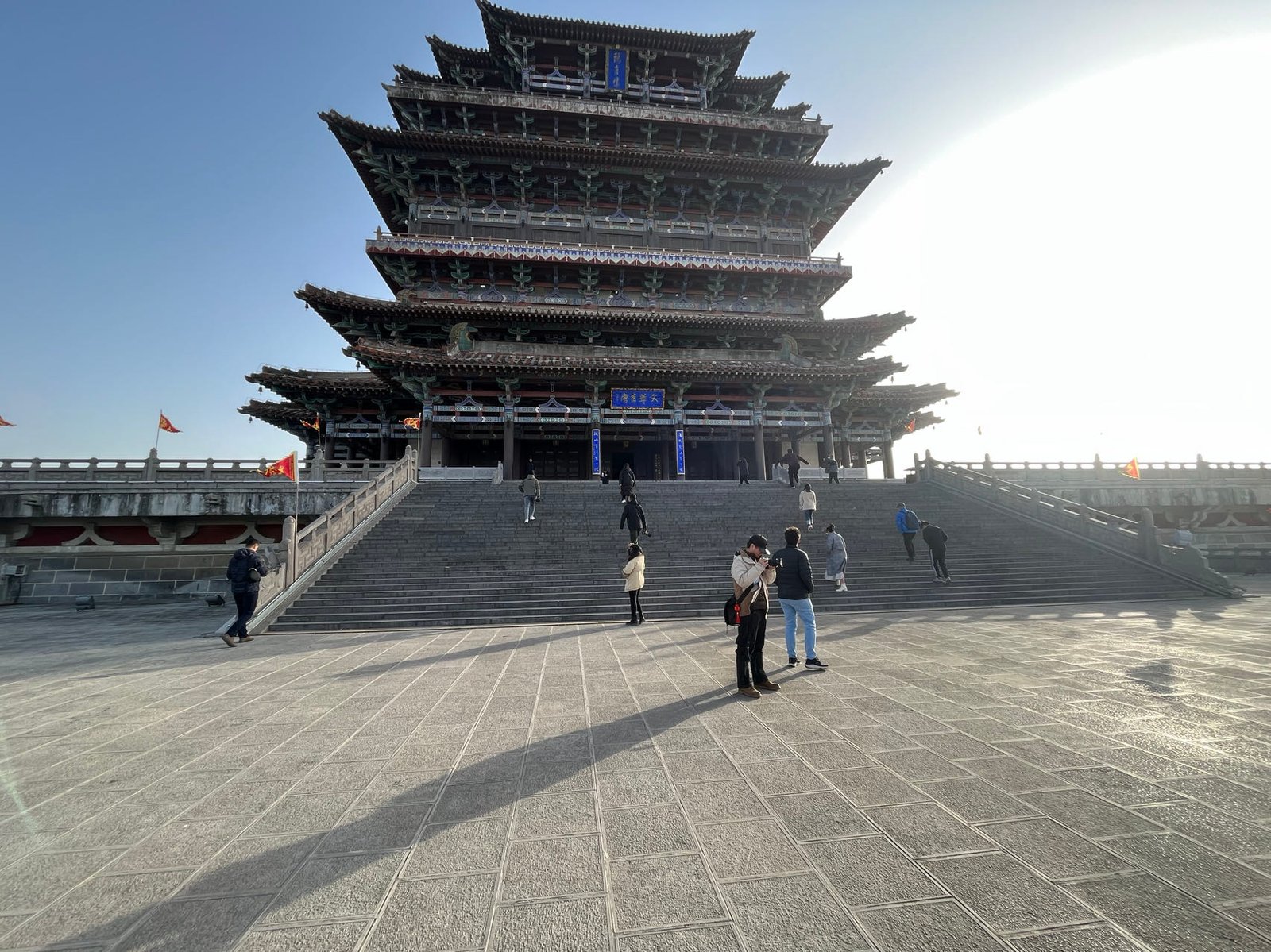

Nestled in the county-level city of Yongji in Shanxi Province, North China, the Stork Tower, or Guanquelou, basks in the winter sunlight, much like it did centuries ago during the Tang Dynasty. This historic monument, which inspired the famous poem “On the Stork Tower” by Tang poet Wang Zhihuan, continues to be a beacon of Chinese cultural heritage.
The poem “On the Stork Tower” by Wang Zhihuan, written during his lifetime from 688 to 742 AD, is a well-known piece that captures the majestic beauty of the landscape:
“The setting sun beyond the mountains glows, The Yellow River seaward flows. One can enjoy a grander sight, By climbing onto a greater height.”
The Stork Tower we see today is a reconstructed version that began construction in 1997 and opened to visitors in September 2002. It stands as a modern reimagining of a Northern Zhou Dynasty (557-581) military lookout post. The original tower, situated on the outskirts of the then city of Puzhou by the Yellow River, shifted from a military structure to a habitat for storks and other birds during the Sui Dynasty (581-618), giving it its name. These birds can still be spotted in the area, linking the present with the past.
The current Stork Tower is located a few kilometers from the original’s site, which was lost to a fire around 1222 AD. Unlike the original three-story wooden structure, today’s Stork Tower stands at 57.4 meters tall, reaching a total height of 73.9 meters including the staircase, and comprises six floors. It now sits near the present course of the Yellow River, reflecting the river’s natural shifts over time.
Inside, visitors can find a wood carving display that transports them back to Tang Dynasty’s Puzhou, once a bustling city alongside Chang’an (now Xi’an) and Luoyang. The carving depicts the ancient tower amidst the city and the Yellow River, complete with drum and bell towers, a port, a bridge stabilized by iron horse sculptures, and the surrounding Zhongtiao and Mount Huashan. Puzhou’s vibrancy and its strategic location are vividly brought to life.
Visitors ascending the Stork Tower pass through a garden, which, when viewed from the tower’s upper balcony, forms the Chinese character “xi,” symbolizing joy. Guanying Lake, shaped like bird wings, pays tribute to the tower’s historical connection with waterbirds.
Atop the tower, a statue of Wang Zhihuan stands, gazing at the Yellow River in the distance, pen and paper in hand. Wang’s journey to Puzhou and his creation of “On the Stork Tower” have made the site a pilgrimage for those who seek inspiration from his words. The poem’s themes of perseverance and determination have resonated beyond China, featuring in textbooks in Japan and worldwide.
Today, the Stork Tower is not just an architectural marvel; it’s a portal to China’s rich poetic and historical past. It serves as a reminder of the country’s enduring cultural legacy, inviting visitors from near and far to experience the same awe-inspiring views that once captivated a Tang Dynasty poet.
READ MORE: