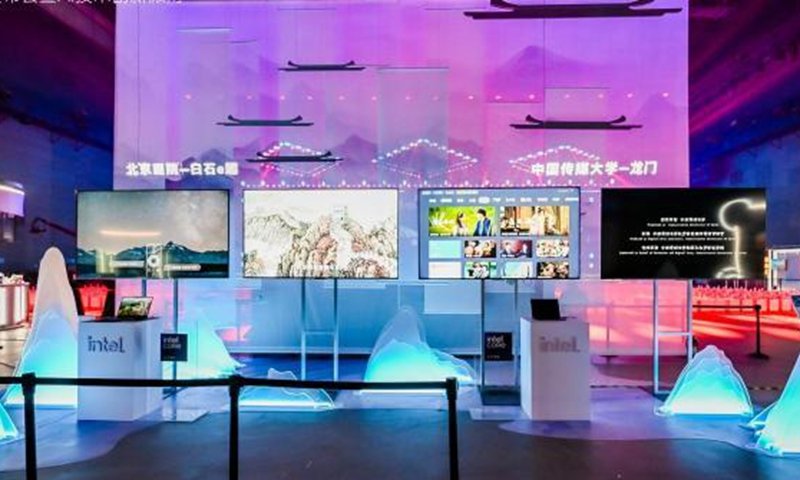

In a groundbreaking move, four prestigious art institutes in China have announced their intention to incorporate artificial intelligence (AI) into their digital art explorations. This initiative underscores the growing significance of AI in enhancing the efficiency and creativity of artistic content generation. The announcement was made at a forum hosted by Intel, a leading US technology company, where an AI model impressively reproduced a work by renowned Chinese master painter Qi Baishi.
Wu Hongliang, the head of the Beijing Fine Art Academy, highlighted the potential of AI technology in the context of Chinese art. As the academy prepares to celebrate the 160th anniversary of Qi Baishi’s birth in 2024, Wu emphasized how AI can provide instantaneous access to all relevant information in a Chinese painting. This includes offering insights into the painting’s perspectives at a remarkable speed, thus enhancing the viewing experience.
Wang Lei, dean of the School of Animation and Digital Arts at the Communication University of China, emphasized AI’s proficiency in crafting detailed elements. He pointed out that AI significantly reduces the time and labor costs associated with traditional animation, particularly in depicting complex and grand scenes. The evolution of hardware and AI technology not only empowers artists but also expands their creative horizons.
AI’s role in art is not limited to technical assistance; it also serves as a source of inspiration and a tool for artistic exploration. According to Wang, AI can fulfill artistic aspirations and spark diverse artistic ideas across various fields. This enables creators to concentrate their energy on self-expression and innovation.
Two other prominent figures in the realm of AI and art are Wu Qiong, a professor at the Academy of Arts and Design at Tsinghua University, and Feng Mengbo, the dean of the School of Experimental Art at the Central Academy of Fine Arts. Both are recognized for their pioneering work in creating interactive art installations using AI technology.
In a significant development, the Communication University of China, Tsinghua University, and the Central Academy of Fine Arts are set to launch a joint project. This initiative aims to cultivate future talents in AI-generated content, preparing a new generation of artists and technologists to navigate the intersection of AI and art. This collaboration reflects a broader trend of technology and art converging, offering new possibilities and redefining the boundaries of artistic creation and expression. As AI continues to evolve, its integration with art promises to unlock unprecedented opportunities for innovation, creativity, and cultural expression.
READ MORE: