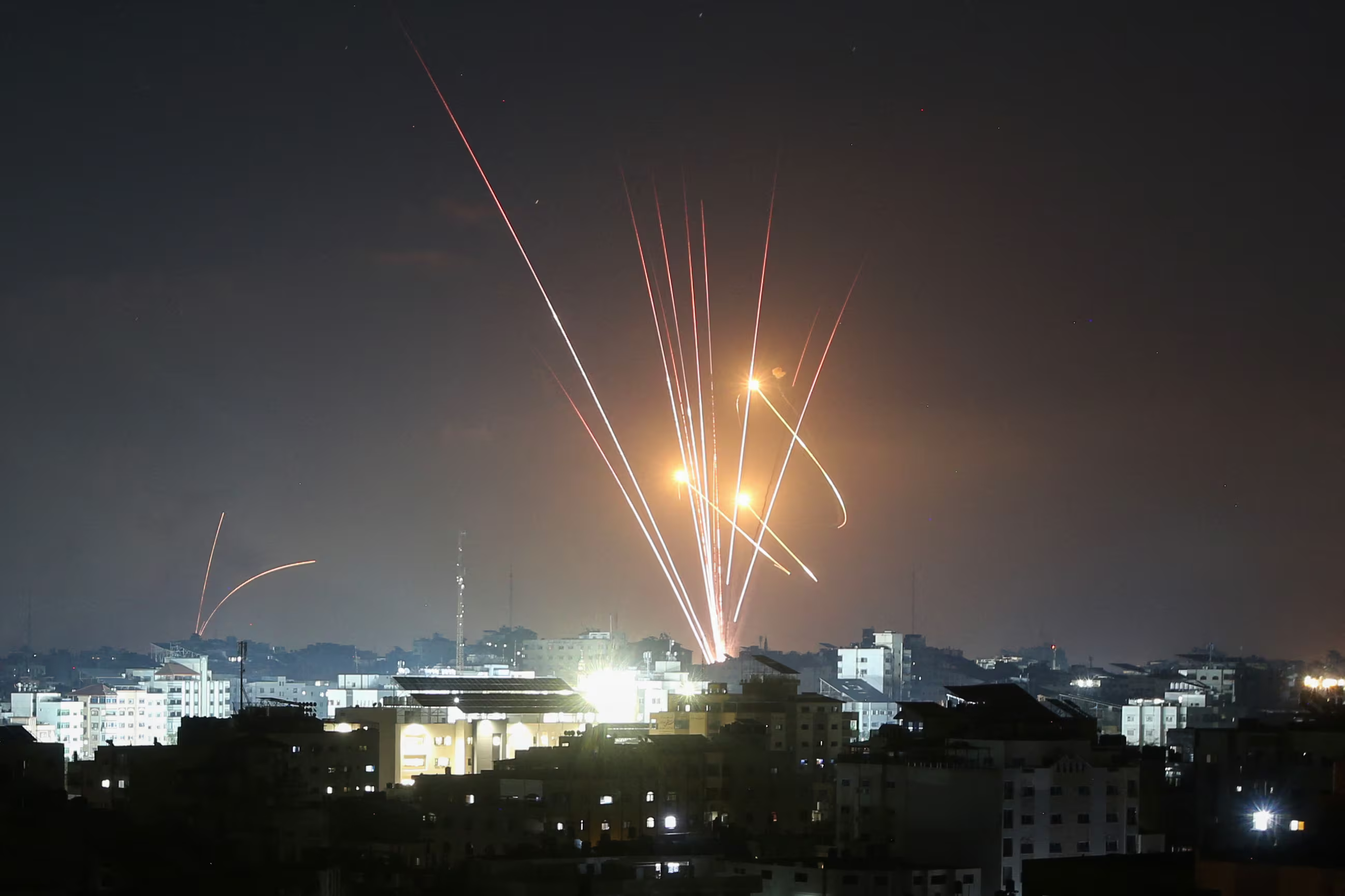

The Pentagon’s ambitious “Golden Dome” missile defense system has seen its estimated cost surge to $185 billion, a significant increase from initial projections. This escalation is driven by the program’s expansion into space-based capabilities designed to bolster homeland defense against a growing array of aerial threats. The project, inspired by Israel’s Iron Dome, is now slated for completion in 2035, a delay from earlier timelines.
Space Force General Michael Guetlein, leading the Golden Dome initiative, announced the revised cost estimate, attributing the $10 billion increase to the need for “additional space capabilities.” These enhancements include the integration of a space data network, an Advanced Missile Tracking Initiative, and the Hypersonic and Ballistic Tracking Space Sensor (HBTSS). These additions aim to provide more precise tracking of incoming missiles and improve the ability to counter offensive strikes.
Originally envisioned under the Trump administration with an estimated cost of $125 billion, the Golden Dome project has already received $25 billion in congressional funding. Guetlein clarified that while an operational capability demonstration is targeted for the summer of 2028, there is no strict “2028 mandate” for full completion. The projected completion date is now 2035.
Nine prominent defense companies, including Lockheed Martin, Northrop Grumman, and RTX, are participating in the Golden Dome project. These companies collaborate on developing the system’s command and control layer, with Guetlein emphasizing a peer-review process where companies can hold each other accountable for performance. A primary challenge identified by Guetlein is not the technology itself, but the “scalability and affordability” of solutions to meet the evolving threat landscape. The focus is on reducing the cost per interceptor to ensure the system can be scaled effectively against potential attacks.
Guetlein pushed back against external estimates that place the program’s cost in the trillions, arguing they are based on different architectural assumptions. He stressed that the key to affordability lies in scaling production and innovation, potentially through technologies like directed energy weapons that could engage multiple targets more cost-effectively than traditional interceptors. The development of a robust command-and-control system is considered the “secret sauce” of Golden Dome, designed to seamlessly integrate sensors, decision-makers, and interceptors across all domains.