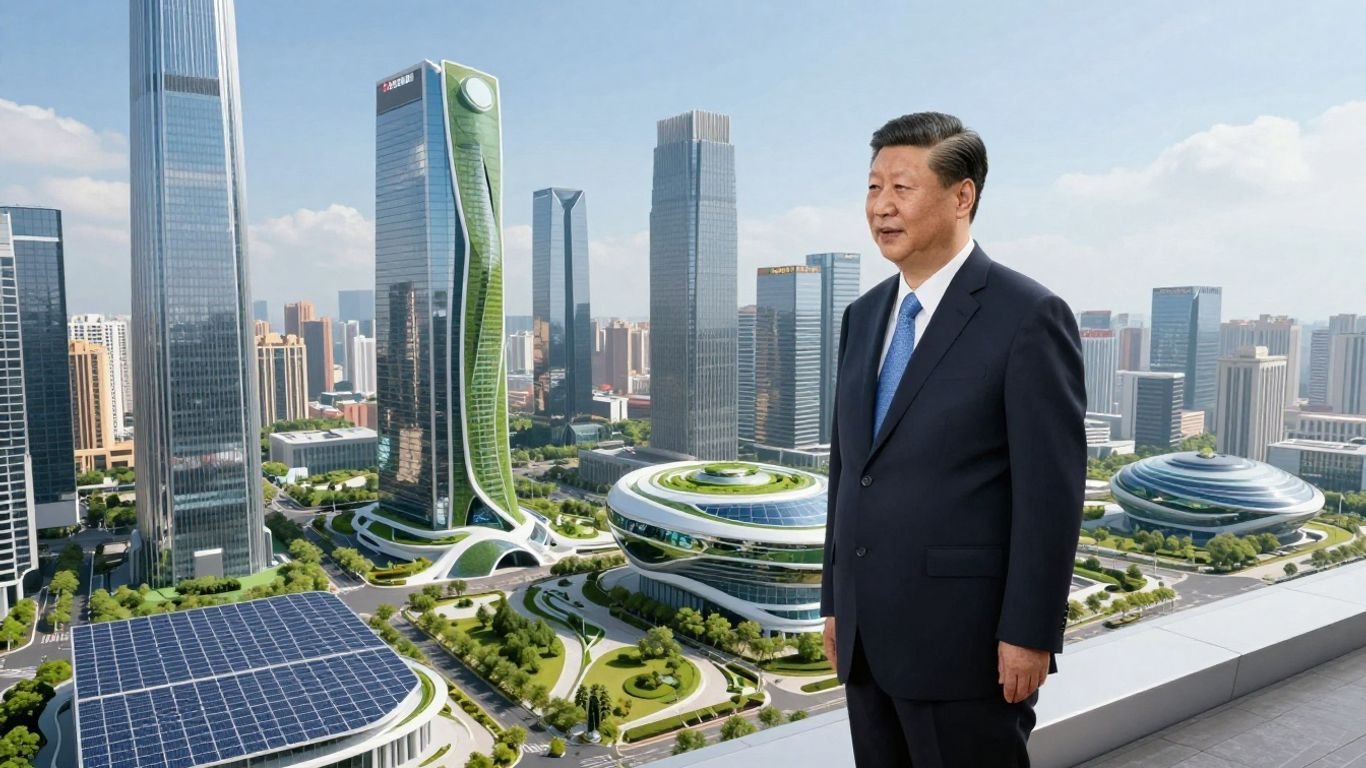

Chinese President Xi Jinping has made a high-profile visit to Xiong’an New Area, signaling renewed urgency behind the ambitious drive to transform the city into a cutting-edge innovation and policy hub. Despite long-standing challenges in attracting talent and industry, Beijing is determined to solidify Xiong’an as a flagship for China’s future growth.
Xiong’an, located about 100 kilometers southwest of Beijing, was conceived nearly a decade ago to ease the capital’s administrative and population pressures. The government aims for Xiong’an to host up to five million people by 2035 and serve as a “15-minute city,” where daily needs are within a short walk or bike ride.
The city is not just envisioned as a physical expansion but as a laboratory for new policies in technology, finance, and industrial development. Initiatives include relocating major state-owned enterprises, universities, and hospitals, and piloting business-friendly regulations intended to accelerate commercialization of research.
Recent years have seen a marked acceleration in the relocation of government departments and companies to Xiong’an. According to observers, multiple flagship enterprises and research institutions have initiated moves—often with central encouragement if not direct mandate. However, population growth and organic economic activity have lagged behind infrastructure expansion.
Some critics and urban analysts have questioned the city’s intrinsic appeal, noting that efforts to attract businesses and people appear top-down. Social media discussions highlighted doubts over the decision-making transparency and genuine livability of the region. The term “ghost city” surfaces periodically in both domestic and foreign commentary.
Xiong’an is presented as a showcase for China’s ability to marshal resources on a massive scale. By clustering talent, industry, and capital, the leadership hopes to create powerful innovation engines. Policy plans call for integration of advanced manufacturing, fintech, and R&D zones, such as the Xiong’an Zhongguancun Science Park.
However, experts caution that forced relocation and state-led development could risk replicating inefficiencies found in other planned cities. Organic innovation typically thrives in competitive, flexible environments rather than administratively designed clusters. Questions remain over whether subsidized businesses and institutions can replace the dynamism of Beijing’s natural ecosystems.
Xiong’an’s future hinges on its ability to convert ambitious visions into vibrant, self-sustaining urban life. The government’s strong hand can accelerate early development but also creates pressure for tangible results. Successful integration of technology, industry, and livability could yet offer a blueprint for China’s next phase of urban and economic evolution. Continued monitoring will reveal whether Xiong’an becomes a symbol of state-driven innovation—or a cautionary tale about the limits of planning.