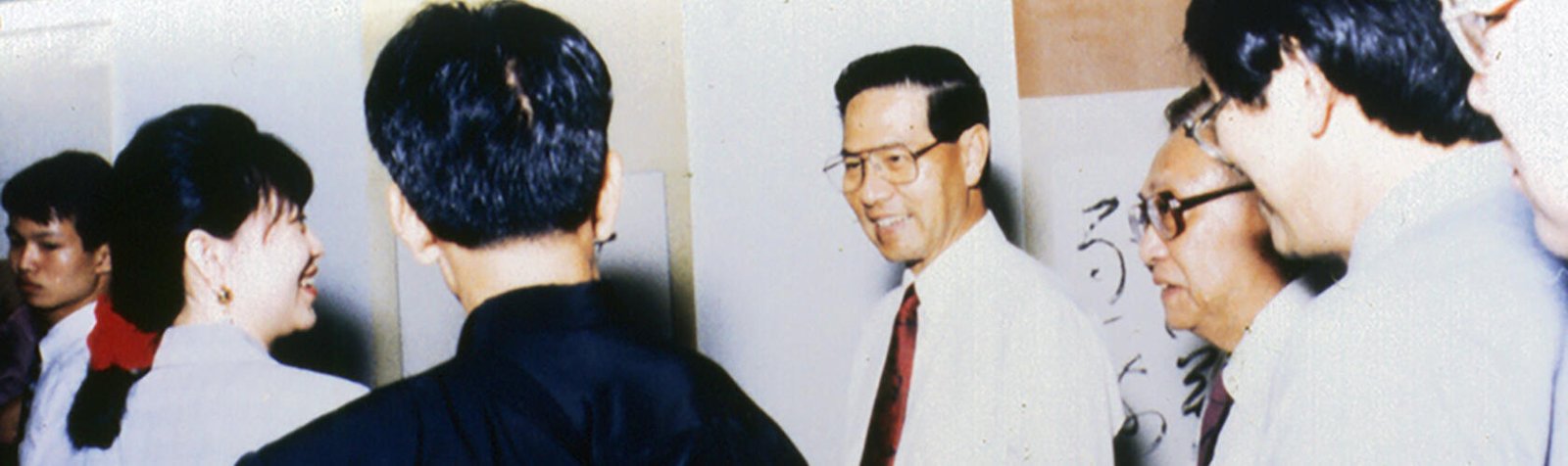

At Singapore’s renowned ShanghART Gallery, Tang Da Wu, an 80-year-old icon in the Singaporean art scene, defies convention. With a crowd watching, Tang uses his fingers to paint an image directly onto the gallery walls—a daring snake entangling a boat. This audacious performance forms part of his exhibit “3, 4, 5, I Don’t Like Fine Art”.
Tang’s approach to art is as unexpected as his subject matter. Rather than create prepared sketches, he dives in, taking risks, and frequently surprising himself. His candid demeanor and willingness to explore the unfamiliar have made him one of Singapore’s most celebrated artists since the 1970s. He captures audiences with impromptu street performances and expansive installations, often tackling pressing societal and environmental topics.
Goh Chun Aik, ShanghART Singapore’s director, underscores Tang’s significance in introducing avant-garde art forms and movements to both Singapore and the broader region. Tang’s influence is especially apparent in The Artists Village (TAV), an innovative collective he established in 1988 in Sembawang. At a time when the Singaporean art community predominantly embraced modernist painting and sculpture, Tang broke the mold, carving a space for artists to question conventional art.
The recent snake motif in his art traces back to TAV, situated amidst durians, livestock, and snakes. Tang recalls encountering these creatures daily, and they often made appearances in his dreams. These memories, combined with his deep connection to the land, especially the earth from Sembawang, infuse his artwork with a raw, organic feel.
Bridget Tracy Tan of the Nanyang Academy of Fine Arts has collaborated with Tang and describes his work as “genuine” and relatable. The show displays a life-sized humanoid crafted from wire and plaster, clutching a vast metal feather, a nod to Tang’s deep-seated beliefs in maintaining childlike innocence and wonder.
Sadly, TAV faced closure by government authorities in a land repossession move just two years after its inception, a reality Tang commemorates through a gripping metal bird sculpture, encapsulating the sense of loss.
After two decades in the UK, where he immersed himself in diverse art forms, Tang brought a wealth of knowledge back to Singapore in 1979. Here, despite facing criticism, such as when his Gully Curtains (1979) installation was quickly removed from the National Museum Art Gallery, Tang remained steadfast. He went on to form TAV, fostering a community of artists and spearheading groundbreaking exhibitions.
Throughout his career, Tang’s works have often doubled as protests, highlighting issues like environmental degradation and animal endangerment. His dedication to active audience engagement remains evident. In recent years, he initiated the performance group La Tristesse Opera, comprising educators, students, and fellow artists.
Tang’s unwavering commitment to teaching, as well as his constant drive to innovate, is symbolized in the exhibit by a set of large paper legs covered in mud, breaking through the gallery’s confines. For Tang, this artwork embodies a core belief: continuously embracing the unknown and eschewing the comfort of the familiar.
READ MORE: