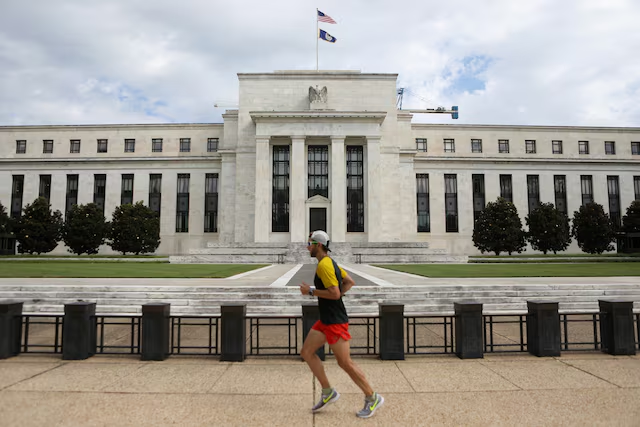

U.S. Federal Reserve policymakers received new evidence on Friday suggesting significant progress in their ongoing battle against inflation. This development has fueled expectations that the Fed will use its upcoming meeting to signal potential interest-rate cuts starting in September.
The personal consumption expenditures (PCE) price index, a key measure of inflation, edged up by just 0.1% in the past month, according to the Commerce Department’s Bureau of Economic Analysis. This modest increase puts the year-over-year rise at 2.5%, a slight decline from May’s 2.6% and edging closer to the Fed’s target inflation rate of 2%.
Fed officials have consistently stated their goal of ensuring that inflation is sustainably moving back towards the 2% target before initiating any rate cuts. Despite the recent progress, inflation remains slightly above the desired level, suggesting that the policy rate will likely be maintained in the 5.25%-5.5% range during next week’s Federal Open Market Committee (FOMC) meeting.
Rubeela Farooqi, chief US economist at High Frequency Economics, commented on the situation, stating, “From the Fed’s perspective, cumulatively, we think the data show enough progress – on both inflation and labor market conditions – for policymakers to open the door to a rate cut in September at next week’s FOMC meeting.”
Following the release of the latest data, traders of futures tied to the Fed policy rate slightly increased their bets that the Fed will implement three rate cuts by the end of the year.
The core PCE prices, which exclude the more volatile food and energy prices and are closely watched by the Fed as an indicator of future inflation trends, rose by 0.2% last month. This was a bit higher than the 0.1% increase projected by economists. The core PCE is considered a more stable measure of inflation and plays a crucial role in shaping the Fed’s policy decisions.
The data on the PCE price index, coupled with the ongoing evaluation of labor market conditions, provides the Fed with a clearer picture of the current economic landscape. As the FOMC meeting approaches, the central bank is expected to carefully assess these indicators to determine the most appropriate course of action.
The potential for rate cuts reflects the Fed’s commitment to balancing economic growth with inflation control. By signaling possible adjustments in interest rates, the Fed aims to support sustained economic expansion while ensuring that inflation trends remain manageable.
As the financial markets react to these developments, the anticipation of rate cuts underscores the dynamic nature of monetary policy and its impact on the broader economy. Investors and analysts will be closely watching the outcomes of the upcoming FOMC meeting for further insights into the Fed’s strategy moving forward.
READ MORE: