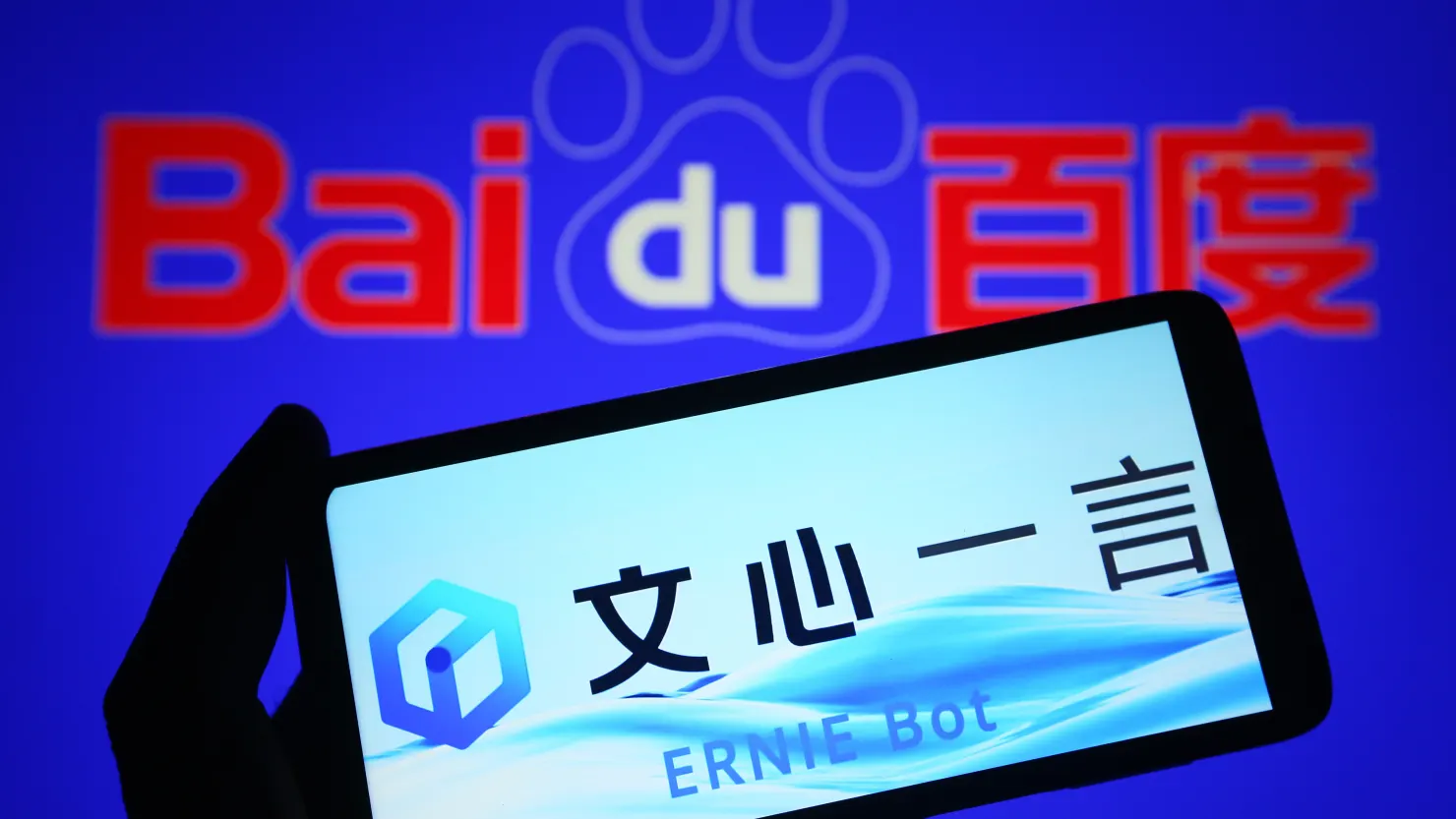

Baidu shares surged in Hong Kong on Wednesday, climbing nearly 16% as the company doubled down on artificial intelligence, a shift that has attracted strong investor attention and led to a ratings upgrade. The Beijing-based tech giant, best known for its dominant search engine, also saw its American depositary receipts rise almost 8% overnight in U.S. trading.
The rally followed an upgrade from Arete Research Services, which lifted its rating on Baidu to “buy” from “sell,” citing a brighter outlook for its AI chip and cloud-computing business. Analysts said Baidu’s push into semiconductors and AI infrastructure could more than compensate for weakness in its traditional online advertising segment, which has struggled in recent quarters.
Baidu has been investing heavily in its AI ecosystem, including designing its own chips to support large language models and its AI chatbot Ernie Bot. By developing in-house technology, the company hopes to reduce dependence on U.S. chipmaker Nvidia, whose products face export restrictions from Washington. This move positions Baidu not only as a software player but also as a serious competitor in China’s AI hardware race.
The company’s stock has already gained nearly 59% this year, despite reporting a drop in second-quarter revenue as advertising softness weighed on performance. Investors appear to be betting that Baidu’s AI pivot will pay off in the long run, particularly as it secures high-profile partnerships. Earlier this week, Baidu announced a deal with China Merchants Group, a major state-owned conglomerate with businesses in transportation, finance, and real estate. The collaboration will focus on large language model applications, AI agents, and so-called “digital employees,” aiming to drive industrial intelligence in real-world settings.
At the same time, Baidu has turned to the bond market to finance its transformation. On Tuesday, the company announced a 4.4 billion yuan ($56.2 million) offshore bond offering, following a $2 billion bond issuance earlier this year. Rivals like Tencent are also tapping debt markets to fund aggressive AI investment, underscoring the scale of capital required to compete in this fast-moving sector.
Baidu also showcased its latest breakthroughs at a recent developer conference, unveiling Ernie X 1.1, its newest reasoning model. The company claimed its performance outpaced that of DeepSeek, one of China’s rising AI startups. Market observers note that Baidu’s growing capital commitments signal an “all-in AI pivot,” reflecting its determination to redefine itself beyond advertising.
READ MORE: