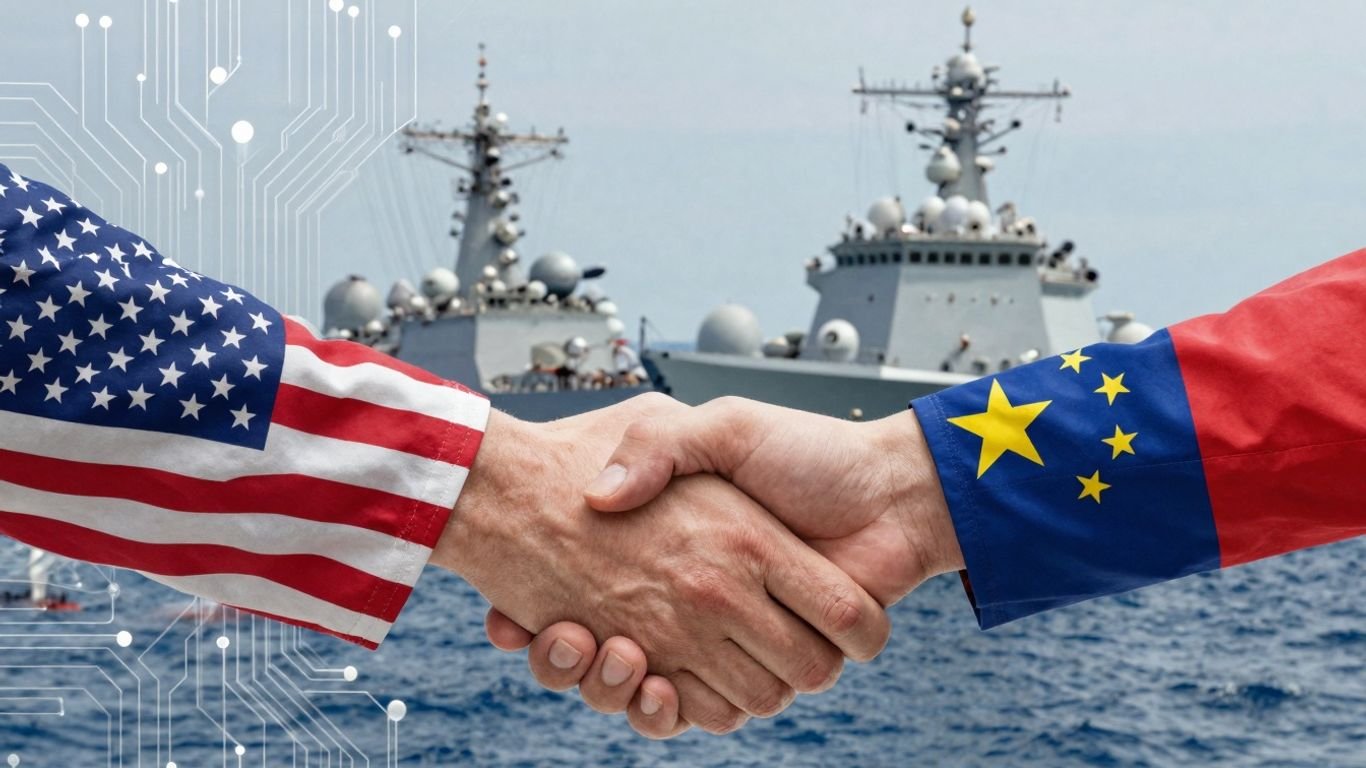

The United States and China are navigating a complex and evolving relationship, marked by a recent shift in U.S. national security strategy that emphasizes economic competition over broader geopolitical challenges. This recalibration comes as both nations grapple with technological advancements, supply chain vulnerabilities, and strategic positioning on the global stage.
A New National Security Strategy
The Trump administration’s latest National Security Strategy signals a notable pivot in how it addresses China. Unlike previous strategies that labeled China as a “geopolitical challenge” or a “revisionist power,” the current document primarily frames the relationship as an economic rivalry. This shift, which largely omits concerns about authoritarianism or human rights abuses, has been cautiously welcomed by Beijing, which has reiterated its interest in “mutual respect, peaceful coexistence and win-win cooperation.”
However, some analysts in China interpret this change in language as a tactical maneuver rather than a genuine retreat, suggesting the U.S. may be seeking a more advantageous position for future negotiations. The strategy explicitly states that “economics are the ultimate stakes” and vows to “rebalance America’s economic relationship with China, prioritizing reciprocity and fairness to restore American economic independence.”
The Race for Technological Dominance
Beyond trade, the U.S. is increasingly concerned about China’s advancements in critical technologies. A bipartisan report warns that China is gaining ground in the biotechnology race, posing a risk to U.S. national security and global influence. This concern stems from China’s significant investment in research, manufacturing capacity, and its acquisition of intellectual property.
The U.S. is also actively countering military technological threats from both China and Russia, with a particular focus on integrating artificial intelligence into its defense operations. The Army is undergoing advanced AI training to enhance command and control capabilities, enabling faster target engagement and greater battlefield lethality. This technological arms race is seen as a defining characteristic of future conflicts.
Strategic Alliances and Supply Chain Security
To counter China’s influence, particularly in areas like rare earth minerals and advanced technology, the Trump administration is forming a coalition of allies. The Pax Silica Summit aims to foster cooperation on export controls, foreign investment screening, and securing critical supply chains. This initiative seeks to create an “economic security coalition” to compete with China’s global economic initiatives.
Furthermore, the U.S. is working to secure its own technological future by addressing vulnerabilities in intellectual property rights, especially in the biotech sector. Reforms are being proposed to strengthen patent protections, making the U.S. a more attractive environment for innovation and investment, thereby preventing reliance on foreign powers for strategic capabilities.
The Taiwan Question
While the new NSS downplays broader geopolitical competition, it places a significant emphasis on Taiwan. The document dedicates multiple paragraphs to the island’s strategic importance, particularly its dominance in semiconductor production and its role in global shipping lanes. The U.S. reiterates its commitment to deterring conflict in the Taiwan Strait, though the language regarding unilateral changes to the status quo has softened.
This nuanced approach to Taiwan reflects the delicate balance the U.S. seeks to maintain, acknowledging Beijing’s claims while upholding unofficial ties and arms sales to the island. The response from Taiwan is one of cautious observation, awaiting clearer signals of sustained U.S. support.
Sources
- Trumps’ security strategy is making a hard pivot on China. Why now?, CNN.
- Former ambassador: China is winning the biotech race. Patent reform is how we catch up, Fortune.
- Trump enlists 5 allies to counter China on rare earths and tech, Politico.
- Opinion | Nvidia selling chips to China undermines Trump protectionism rationale, The Washington Post.
- US countering military tech threats from Russia and China with AI, NewsNation.