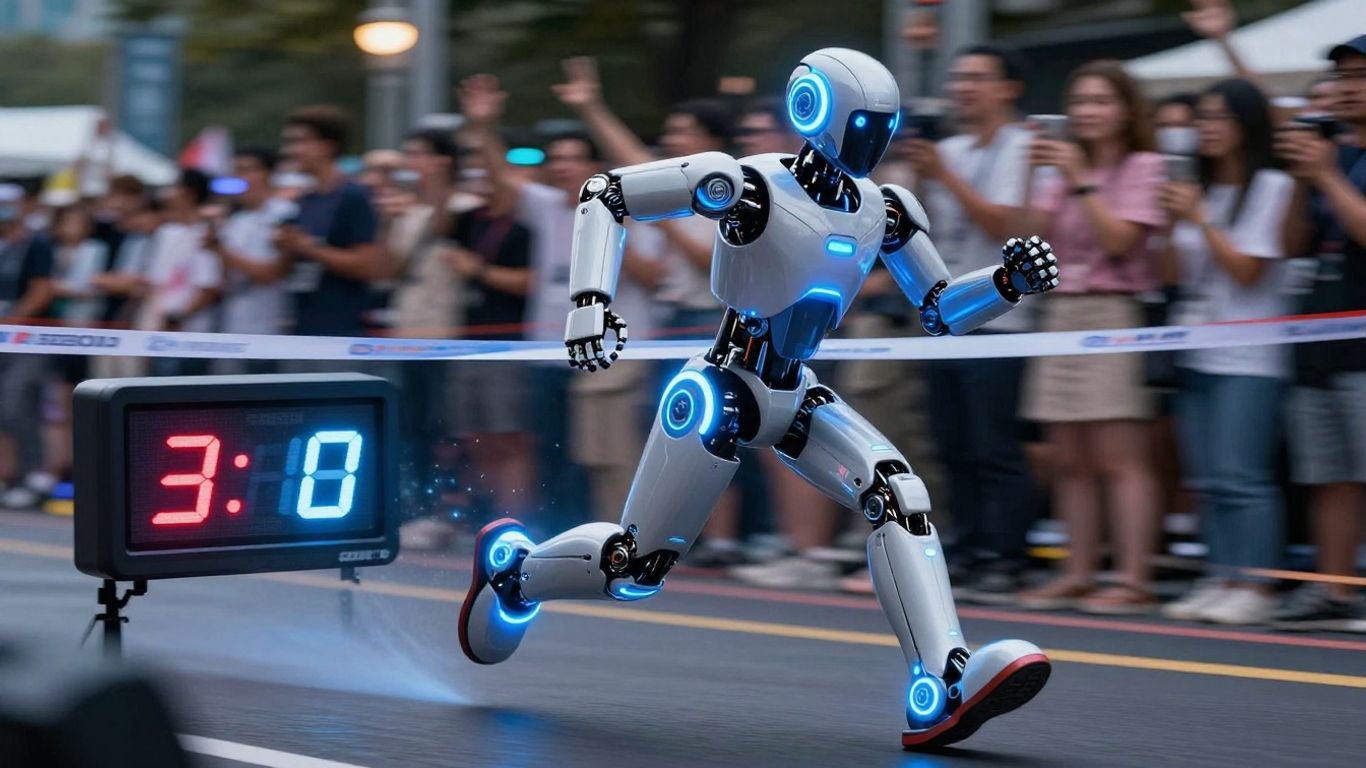

Dozens of advanced humanoid robots showcased remarkable athletic prowess at the Beijing E-Town Humanoid Robot Half-Marathon on Sunday, with several machines significantly outperforming elite human runners and even breaking existing world records. This year’s event marked a dramatic leap in robotic capabilities compared to its inaugural predecessor.
The second annual Beijing E-Town Humanoid Robot Half-Marathon saw over 100 robot teams compete alongside approximately 12,000 human runners. The robots ran on parallel tracks, separated by barriers for safety. The contrast with the previous year was stark; in 2025, the fastest robot took over two hours to finish, whereas this year, the winning robot, named ‘Lightning’ and developed by Chinese tech firm Honor, completed the 21.1 km course in an astonishing 50 minutes and 26 seconds. This time shattered the human world record of 57:20 set by Jacob Kiplimo.
Honor’s dominance was evident, with their ‘Lightning’ robots securing all three podium positions. The second and third-place robots finished in approximately 51 and 53 minutes, respectively. Notably, the competition rules prioritized autonomous navigation, meaning a remotely controlled ‘Lightning’ robot that finished in an even faster 48 minutes and 19 seconds did not take the overall win.
This year’s event saw a significant shift towards autonomous operation, with about 40% of the robots navigating the course independently using on-board sensors and AI, a considerable increase from the remotely controlled machines of the inaugural race. The robots utilized advanced liquid cooling technology, adapted from smartphones, to manage the heat generated during the intense runs. Engineers highlighted design features like extended leg structures, mimicking elite human running mechanics, and robust anti-interference capabilities.
Beyond speed, the event showcased improvements in terrain adaptability, endurance, and overall running posture. Robots demonstrated stable takeoffs, a marked improvement from the balance issues faced by many in the previous year. Companies like Unitree also demonstrated their robots achieving speeds close to peak human sprint speeds in shorter distances.
The rapid advancements displayed in the Beijing half-marathon offer a glimpse into the future of robotics. While economically valuable applications are still in trial phases, the machines’ physical prowess suggests potential for reshaping dangerous jobs and even military applications. China is heavily investing in this frontier industry, aiming to become a global powerhouse.
However, experts emphasize that while technically impressive, these racing feats do not yet equate to widespread industrial capability. Significant challenges remain in developing AI systems capable of complex, real-time decision-making and flexible task execution, areas where humans still hold a distinct advantage. Nevertheless, the event underscores the accelerating pace of development in humanoid robotics.