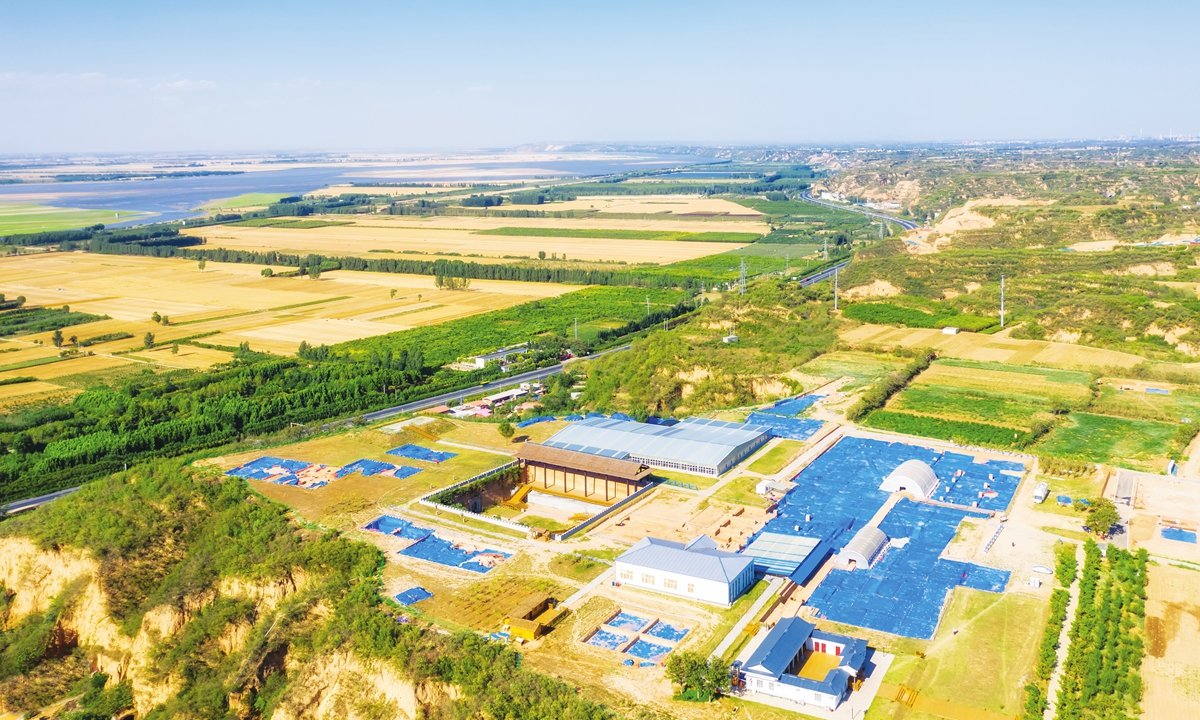

In a significant development for the study of ancient Chinese history, recent archaeological excavations in Central China’s Henan Province have uncovered a rampart defense system dating back 6,300 years. These findings, presented by the Henan Provincial Institute of Cultural Heritage and Archaeology, offer new insights into the early stages of China’s prehistoric society and the Yangshao Culture.
The Yangshao Culture, spanning from 5,000 to 7,000 years ago, is recognized as a pivotal origin point of Chinese civilization. It flourished in the middle and lower reaches of the Yellow River basin and is renowned for its advanced pottery-making techniques. As the first discovered Neolithic culture in China, the Yangshao Culture’s significance in the historical narrative of China is profound, with its name originating from Yangshao village, a landmark in the field of modern Chinese archaeology.
Liu Haiwang, the head of the Henan Provincial Institute, emphasized the importance of the newly discovered defense walls and trenches. These structures symbolize the dawn of prehistoric civilization in China, indicating a level of social complexity and organization previously unseen in this era.
Fang Qi, head of the archaeological excavation team and dean of the School of Archaeology at Jilin University, proposed that these fortifications likely served multiple purposes. Beyond military defense, they might have been employed to protect settlements from elephants, a common threat at the time. This function underscores the adaptive ingenuity of early Chinese societies.
Further discoveries in the region have unearthed medium- and large-sized houses from several archaeological sites, suggesting the formation of an ancient kingdom during the Yangshao Culture’s middle stage. The uniformity in structure, building materials, and construction techniques across different sites points to a mature and rapidly evolving model of house construction.
The late stage of the Yangshao Culture, as indicated by newly found large-scale residences, courtyards, and barbican structures, marks a significant shift in social organization. These findings suggest the emergence of labor division and specialization in the handicraft industry, leading to the differentiation of social classes.
Centered around the Shuanghuaishu Ruins, a large group of settlements provides evidence of an ancient political entity established around 5,300 years ago. This region is considered one of the earliest regional civilizations in China.
A striking discovery related to the residents’ health was also made. After examining human bone remains from the Shuanghuaishu Ruins, researchers found a high prevalence of cavities, attributed to their diet rich in millet, a staple food high in sugar content.
These archaeological breakthroughs, part of a collaborative project initiated in 2020 by the provinces of Henan, Shanxi, Shaanxi, and Hebei, aim to explore the origins of Chinese civilization. The discoveries not only deepen our understanding of the Yangshao Culture but also offer a window into the complexities and nuances of early Chinese societies, revealing a civilization far more advanced and structured than previously understood.
READ MORE: