
The city of Baoji, nestled in Northwest China’s Shaanxi Province, is a treasure trove of history intricately linked to the renowned Silk Road. While Xi’an, the ancient capital, has the distinction of being the Silk Road’s commencement point, Baoji proudly displays cultural relics, showcasing the enduring legacy of Chinese civilization.
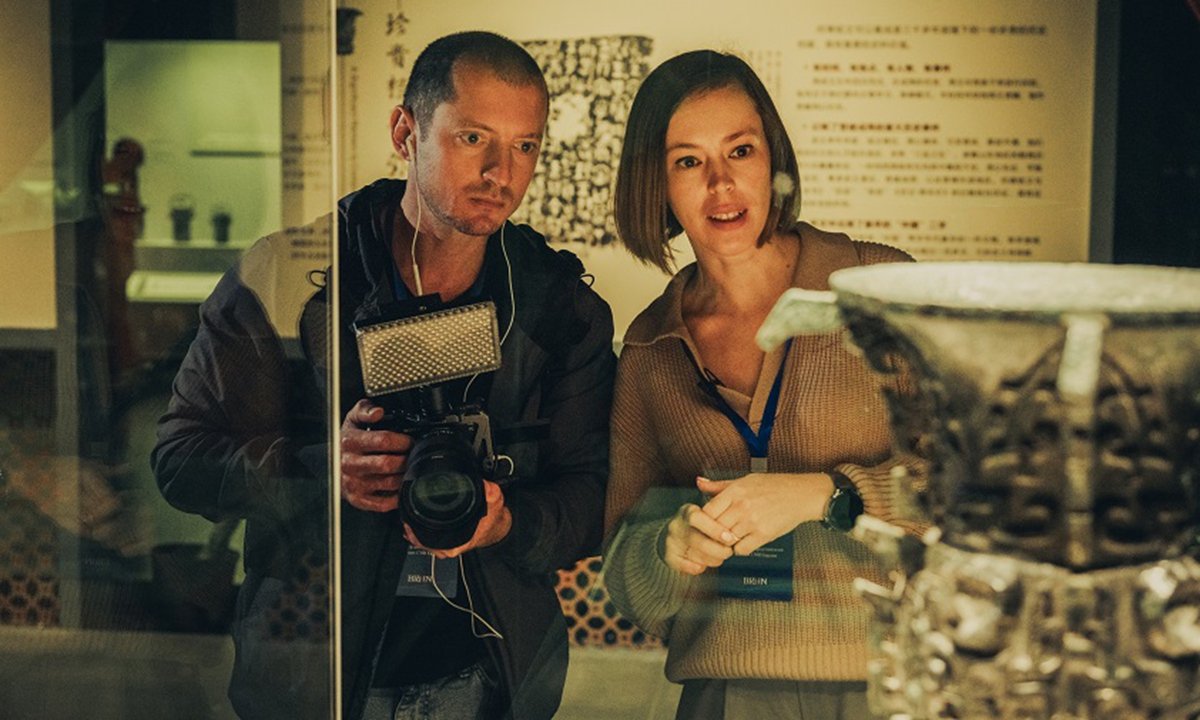
Recently, a delegation consisting of media personalities from 10 Belt and Road countries embarked on a journey through Baoji’s historical landscape. Their first stop was the Baoji Bronze Ware Museum, which houses a breathtaking collection of bronze artifacts. A standout piece is the He Zun, a ritual wine vessel from the Western Zhou Dynasty (1046BC-771BC) that bears the first known written instance of the name “zhongguo” (China). This discovery affirmed that over 3,000 years ago, the inhabitants referred to their land as China. Such revelations underline the significance of the Chinese civilization, which has remained continuous through millennia.
Visiting media members, like Serik Korzhumbayev from Kazakhstan’s DK News Agency, were fascinated by these insights into Chinese history. They believed such experiences should be shared more widely to foster a deeper understanding of China’s complex past and present.
Further accentuating China’s rich heritage was the museum’s extensive collection of drinking vessels. These artifacts, more than just functional items, symbolized China’s multifaceted drinking culture, intertwined with religious, social, and political nuances.
Another highlight of the journey was the exploration of Xifeng Liquor’s factory, where the ancient art of baijiu brewing thrives. Baijiu, a signature Chinese distilled spirit, boasts a brewing tradition that extends back centuries. The delegation was introduced to the unique storage container, Jiuhai, employed in the baijiu brewing process. Lu Shaojun from Xifeng Liquor eloquently explained the meticulous process of crafting these containers, some of which date back to the Qing Dynasty (1644-1911).
Such exposures prompted reactions like that of Alexandru Tanas from Moldova, who was eager to share China’s liquor-making heritage with his compatriots.
The trip concluded on a poignant note with the story of Zhang Qian, a Western Han Dynasty royal envoy. He journeyed to the Western regions, marking the inception of the Silk Road, possibly carrying baijiu as a symbol of friendship. This gesture was emblematic of the cultural exchanges that flourished along the Silk Road, a tradition that persists today.
READ MORE: