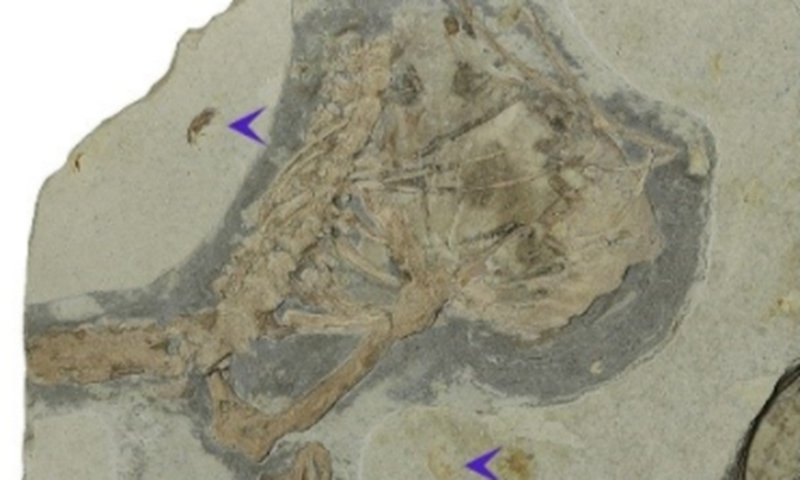

The recent discovery of a new pterosaur species in North China’s Hebei Province, named Cratonopterus huabei, has provided groundbreaking insights into the evolutionary biology of these ancient flying reptiles. Unearthed by a team from the Institute of Vertebrate Paleontology and Paleoanthropology, Chinese Academy of Sciences, this finding is challenging long-standing beliefs in paleontology about pterosaur bone structure and their adaptation for flight.
The name Cratonopterus huabei is derived from Greek, with “Craton” meaning strong or solid, indicating the Earth’s crust layer where the specimen was found, and “pteron” meaning wing, a common suffix used in naming pterosaurs. This new species was discovered in the approximately 130 million-year-old strata of the Jehol Biota, a site in Northeast China renowned for its exceptionally preserved vertebrate fossils, including feathered dinosaurs.
Cratonopterus huabei represents the second pterosaur specimen found in the Huajiying Formation, which marks the early stage of the Early Cretaceous Jehol Biota. Despite the incomplete nature of the fossil, the partial skeleton includes crucial elements such as vertebrae, the sternum, the right scapulocoracoid, and most parts of the right wing. This discovery is significant as the only other known pterosaur from this formation belonged to the Ornithocheiroidea, while Cratonopterus huabei has been classified within the Ctenochasmatidae family.
Jiang Shunxing, a researcher on the team, highlights that Cratonopterus huabei, a medium-sized archaeopterodactyloid with a wingspan of about 1.8 meters, exhibits unique characteristics. These include a large pneumatic foramen on the ventral surface of the first wing phalanx and a coracoid lacking an expansion at its contact with the scapula.
Pterosaurs have traditionally been thought to possess thin, hollow bone structures akin to modern birds, an adaptation believed to reduce weight for flight. The Junggar pterosaurs, in particular, are known for their unusually thick bone walls, considered an evolutionary trait for frequent take-offs.
However, Cratonopterus huabei challenges these traditional views. Despite not being a Junggar pterosaur, it exhibits a thick bone wall structure, suggesting that this feature might not be unique to the Junggar group. This revelation indicates that relatively thick bone walls could be a primitive feature of pterosaurs. Additionally, not all Junggar pterosaurs exhibit thick bone walls, as seen in the thinner walls of the humerus and radius, a phenomenon also observed in flying vertebrates like bats.
The research team proposes that the relative thinning of these bone walls in Junggar pterosaurs, similar to bats, is likely an adaptation for flight, enhancing skeletal resistance to twisting during flapping, rather than solely reducing weight. This new interpretation provided by the team offers a fresh perspective on the evolutionary adaptations of pterosaurs, contributing significantly to our understanding of these ancient creatures and their unique place in the history of vertebrate flight.
READ MORE: