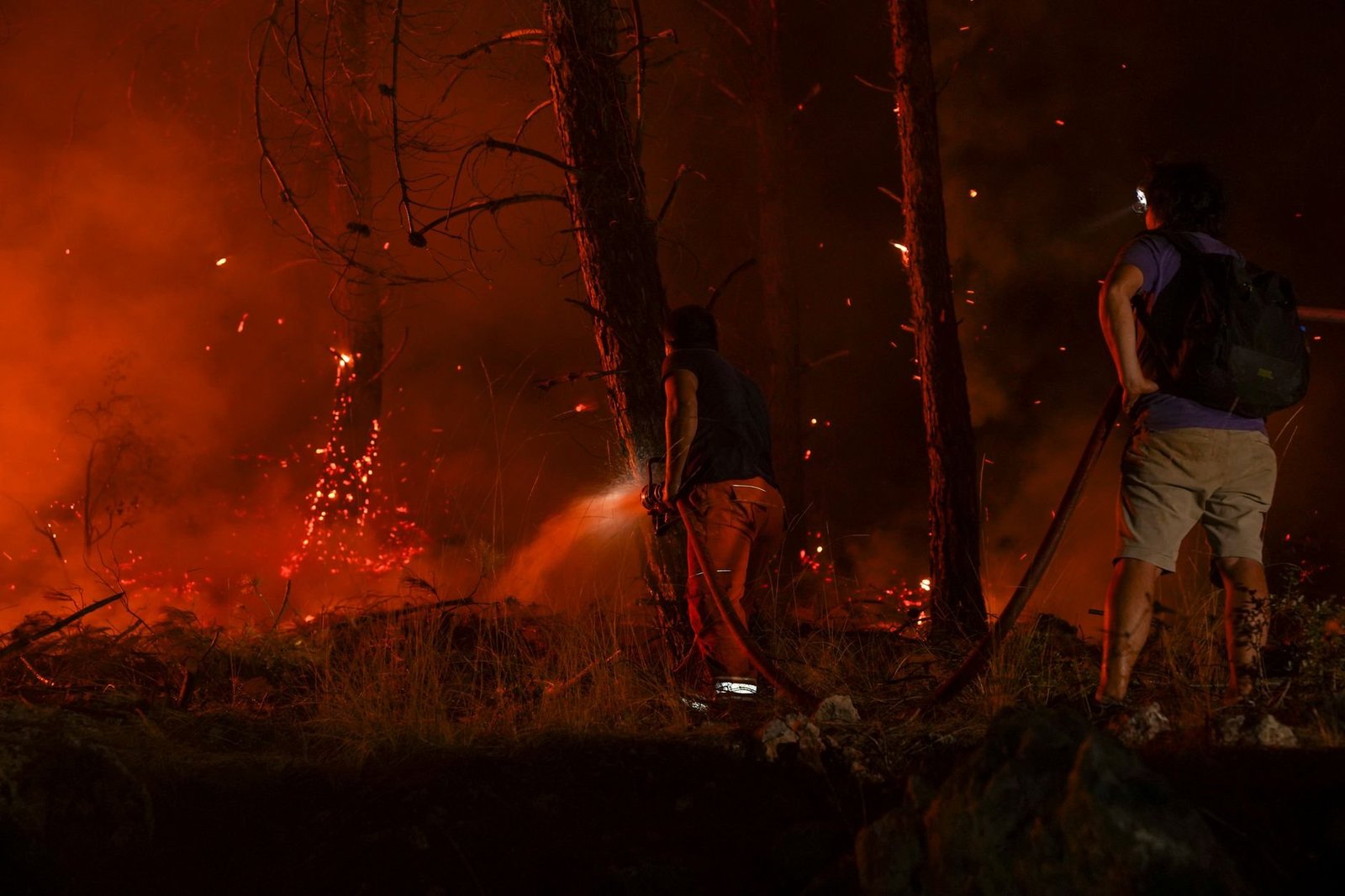

Cooler temperatures and the prospect of rain moved into the wildfire-scarred southwest of France on Thursday, offering the first significant relief for firefighting crews who have battled blazes that scorched an area four times the size of Paris in recent weeks.
Moisture drifting in from the Atlantic coast prompted the national weather service, Meteo France, to forecast light rain in the town of Lege-Cap-Ferret, situated on a peninsula that has been at the leading edge of the devastated region.
Temperatures that peaked around 40 degrees Celsius (104 Fahrenheit) a day earlier were expected to drop sharply, topping out at 27 C (80 F) along the coast. An “orange” heat wave alert — the second-highest level below “red” — was lifted shortly before dawn.
Local officials reported a “rather calm” night, noting that the main fire had not spread beyond the 42,000 hectares (about 162 square miles) already affected. Fire crews remained at what authorities described as “total mobilization,” with 2,200 firefighters and more than 20 aircraft deployed across the zone.
Humidity that reached 80% overnight was expected to ease by midday, though authorities said some rainfall along the coast “could reach the fire zone,” raising hopes that the worst of the emergency may be passing.
The improving conditions mark a turning point from the intensifying heat wave reported earlier this week, when soaring temperatures fueled rapid fire growth across the Bordeaux wine-growing region, a forested and tourism-heavy area. At the height of the crisis, wildfires forced the evacuation of hundreds of thousands of residents and holidaymakers across France and Spain.
The French fires form part of a broader wave of blazes that have swept pockets of southern Europe in recent weeks, including Spain and Greece. On Wednesday, authorities said three firefighters had died battling a wildfire on the Greek island of Crete, as the emergency stretched from the Atlantic coast to the eastern Mediterranean.
The scale of the destruction has underscored the mounting economic toll of Europe’s increasingly severe summers. Record heat is straining infrastructure, disrupting businesses and driving up insurance costs across the western part of the continent, adding fresh pressure to budgets already stretched by successive extreme-weather seasons.
The mass evacuations seen across the region in recent days illustrated how quickly the blazes overwhelmed local authorities, with a third of a million people driven from homes and vacation sites at the peak.
While the shift in weather offers a welcome reprieve, officials cautioned that crews would remain fully mobilized until the fires are contained. Forecasters will continue to monitor whether the incoming Atlantic moisture proves sufficient to douse the remaining hotspots or merely slows their advance.