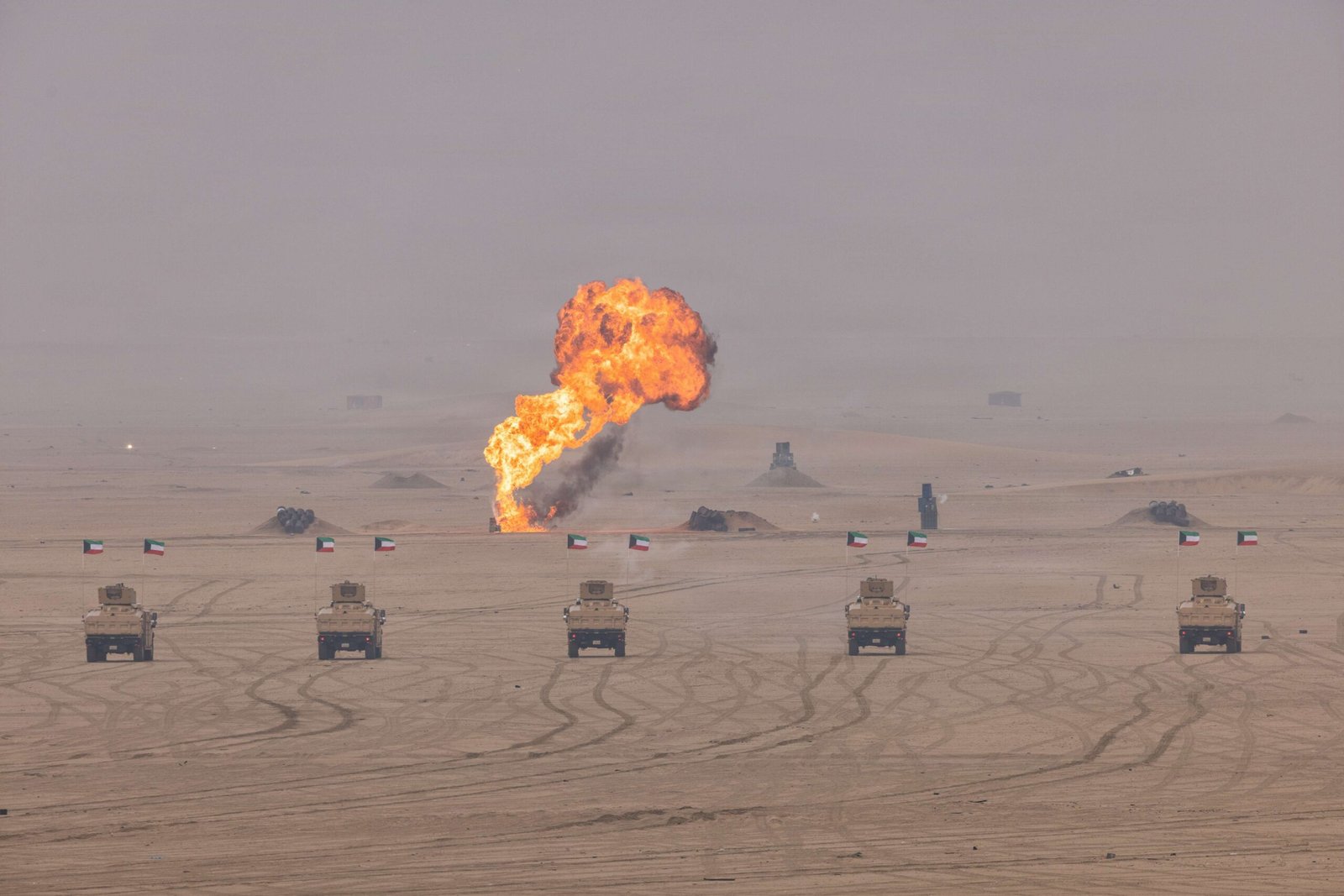

Kuwait’s Ministry of Defense said its air defenses intercepted Iranian missiles and drones early Thursday, describing the assault as a “blatant Iranian aggression” that widened the six-month conflict beyond the Strait of Hormuz.
Sirens sounded across Kuwait before dawn as batteries engaged the incoming fire. The strikes formed part of Tehran’s retaliation for U.S. bombardments earlier in the week that left at least 19 Iranians dead. Iran also hit U.S. military targets in Jordan, the United Arab Emirates, Bahrain and Iraq’s autonomous Kurdistan region.
The Kuwait attack pushed the fighting past the shipping lanes where it reignited. On Sunday, U.S. forces struck Iranian rocket launchers on an island in the Strait of Hormuz, saying Tehran planned to use them to scatter mines across the waterway. Bahrain and Jordan reported intercepting Iranian air attacks on Wednesday.
President Donald Trump said his military was ready to strike Iran “any time we want,” and predicted the renewed hostilities would not continue “too long.” The comments came after Tehran ignored his warnings and pressed ahead with strikes on U.S. installations across the Gulf.
The pattern echoes earlier phases of the war, when Iranian missiles reached bases in Kuwait and Bahrain during a previous round of escalation. Successive intercepts by U.S. allies have so far limited casualties on the receiving end, though the geographic spread of targets has grown.
The Strait of Hormuz remains central to the standoff. Roughly a fifth of global oil supply moves through the channel, and any disruption there carries consequences for shipping and energy prices far beyond the region.
Elsewhere, Israeli police said Thursday they had arrested an Israeli settler suspected of taking part in an attack on a Palestinian home in the occupied West Bank. The 19-year-old is believed to have joined a riot on Saturday in the village of Qusra, where settlers threw stones and barricaded themselves inside a resident’s home. Police, working with Israel’s domestic security agency, said they would seek to extend his detention and locate further suspects.
The arrest followed weeks of settler incursions into Qusra, south of Nablus. Such prosecutions are rare in the territory.
Kuwait’s air defenses reported no casualties from Thursday’s interceptions. The exchange between Washington and Tehran has intensified steadily through the week, with each side signaling readiness for further strikes.