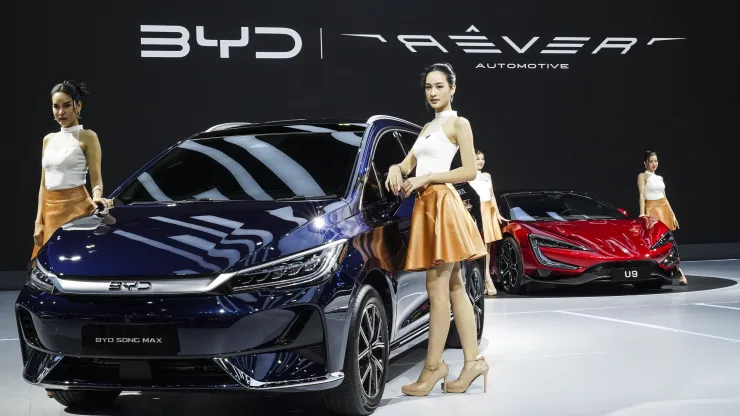

Chinese automakers are projected to capture 33% of the global automotive market share by 2030, according to a new report from consulting firm AlixPartners. This marks a substantial increase from the forecasted 21% market share this year. Much of this growth is expected to come from sales outside China, which are predicted to rise from 3 million this year to 9 million by 2030, increasing their market share from 3% to 13% by the end of the decade.
The rapid expansion of Chinese automakers is causing concern among legacy automakers and global politicians, who fear that the influx of less expensive, China-made vehicles will disrupt markets, particularly with all-electric vehicles. AlixPartners expects Chinese brands to grow across all global markets, with limited expansion in Japan and North America, including the U.S., where stringent vehicle safety standards and a 100% tariff on imported Chinese EVs have been announced.
Mark Wakefield, global co-leader of the automotive and industrial practice at AlixPartners, described China as the industry’s new disruptor, capable of producing must-have vehicles that are faster to market, cheaper, technologically advanced, and more efficiently built.
In North America, Chinese automakers are forecasted to achieve a 3% market share, primarily in Mexico, where one in five vehicles is expected to be a Chinese brand by 2030. In contrast, regions such as Central and South America, Southeast Asia, and the Middle East and Africa are expected to see significant growth in the market share of Chinese automakers.
In China, the market share of domestic brands is anticipated to rise from 59% to 72%. Legacy automakers like General Motors have lost ground in China amid the rapid growth of companies such as BYD, Geely, and Nio. In Europe, where Chinese automakers have already seen substantial growth, their market share is expected to double from 6% to 12% by 2030.
The expansion of Chinese automakers is attributed to their cost advantages, localized production strategies, and tech-enabled vehicles that align with evolving consumer preferences. Andrew Bergbaum, global co-leader of the automotive and industrial practice at AlixPartners, warned that automakers adhering to traditional business practices face obsolescence.
Chinese EV automakers can develop new products in half the time of legacy automakers—20 months versus 40 months—by designing and testing to meet standards without overengineering. They also benefit from a 35% “Made-in-China” cost advantage. Wakefield emphasized that traditional automakers must rethink their business development processes and pace of vehicle development to compete with Chinese automakers.
READ MORE: