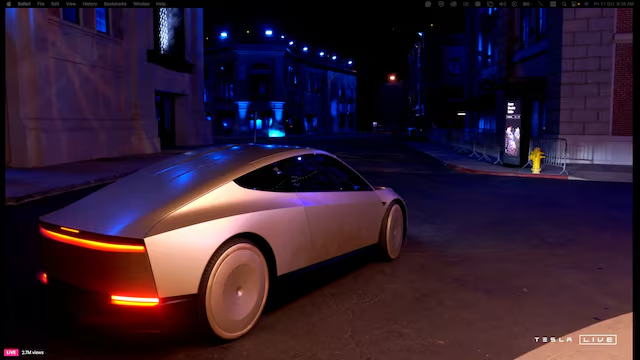

Tesla CEO Elon Musk announced on Wednesday that the electric vehicle giant plans to introduce driverless ride-hailing services in California and Texas next year. This bold claim faces considerable regulatory and technical challenges, but Musk is optimistic that Tesla will be able to offer paid rides in fully autonomous vehicles by 2025. The company currently operates an app-based ride-hailing service for employees in the San Francisco Bay Area, which Musk sees as a foundation for the larger rollout.
During Tesla’s quarterly earnings call, Musk reiterated a pledge he made earlier this month, stating that “we’ll be able to have driverless Teslas doing paid rides next year.” This expansion of the robotaxi vision aims to build on the unveiling of Tesla’s “Cybercab” at the robotaxi event on October 10, a two-seater vehicle without a steering wheel or pedals, designed to navigate autonomously using cameras and artificial intelligence.
However, rolling out fully autonomous services will require navigating complex regulatory frameworks, particularly in California. The California Public Utilities Commission (CPUC) and the Department of Motor Vehicles (DMV) regulate ride-hailing and autonomous vehicle testing in the state. Tesla last used its autonomous vehicle testing permit, which requires a safety driver, in 2019, and has not applied for a permit to test driverless vehicles without a safety driver. Musk acknowledged these challenges but expressed confidence in obtaining the necessary permits, stating, “I would be shocked if we don’t get approval next year.”
Texas, on the other hand, has fewer regulatory barriers for autonomous vehicle deployment, making it an attractive market for Tesla. However, most companies test for extended periods before launching paid services, and Tesla will likely face similar timelines. Musk also called for a national approval process for autonomous driving technology to streamline deployment across the country.
Tesla’s Full Self-Driving (FSD) system, the core technology behind its robotaxi ambitions, has faced scrutiny from regulators. Recently, the U.S. National Highway Traffic Safety Administration (NHTSA) launched an investigation into 2.4 million Tesla vehicles equipped with FSD after several reported accidents, including a fatal crash.
Despite these hurdles, the announcement stirred the market, sending shares of ride-hailing companies Uber and Lyft down by 2.3% in post-market trading. Tesla remains focused on its autonomous vehicle vision, and investors are closely watching as the company aims to revolutionize the ride-hailing industry.
READ MORE: