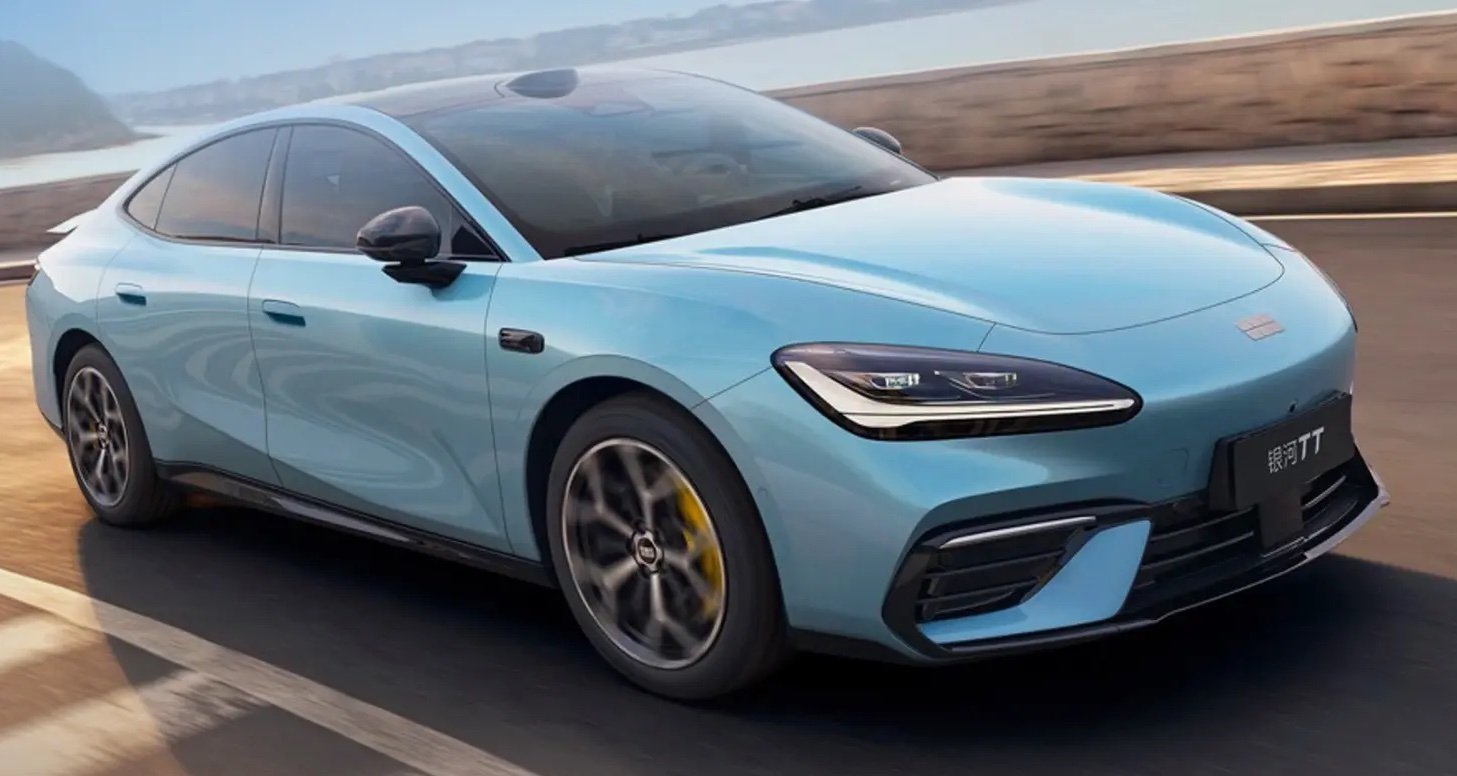

Geely Auto launched its Galaxy TT electric sedan on Sept. 10 at a limited-time starting price of 129,900 yuan, or roughly $19,170, an entry point that undercuts even the cheapest electric cars on sale in the United States.
The Chinese automaker’s Galaxy brand priced the entry version 16,000 yuan below the pre-sale figure announced in August, and added 100 km of range in the process. The base car carries a 63.8-kWh lithium iron phosphate battery from CATL and a rated range of 640 km, about 398 miles, on China’s domestic Light-Duty Vehicle Test Cycle.
Every trim ships with an 800-volt system and 6C fast charging that takes the battery from 10% to 80% in about 11.8 minutes. Rear-drive models produce 245 kW, or 329 horsepower, and reach 100 km/h in 6.5 seconds. At 4,999 mm long, the sedan is bigger than a Toyota Camry.
The second trim adds lidar and Nvidia’s Thor-U chip running Geely’s assisted-driving software, a 15.4-inch center screen and a 25.6-inch augmented reality head-up display.
The cheapest new EV on sale in the U.S., the Nissan Leaf S+, starts at $29,990 before destination, while the average new EV sold for $55,300 in February, based on Cox Automotive data. The $7,500 federal tax credit that helped close the gap expired after Sept. 30, 2025.
The sedan faces substantial duties if imported. A China-built passenger vehicle faces a 2.5% base duty, the 100% Section 301 tariff imposed in 2024, and the 25% Section 232 tariff applied to imported vehicles in 2025 — a stack that would push the sedan past $43,000 at the port before shipping, certification and dealer costs.
The Commerce Department’s Connected Vehicle Rule blocks cars with a meaningful ownership or software connection to China, with software restrictions starting in the 2027 model year and hardware restrictions following in 2030. The rule turns on ownership rather than where a car is assembled.
Geely has encountered those rules. Polestar, the Swedish brand Geely controls, said the Commerce Department declined its authorization for new model variants from the 2027 model year onwards, and on Sept. 3 the company cut its full-year retail sales growth outlook, citing restructuring tied in part to the U.S. decision. Volvo Cars, also controlled by Geely, was cleared in May after reworking how its vehicle data is governed and routed.
Geely has leaned on other export markets, with shipments rising 205% year over year in August to 110,094 vehicles.