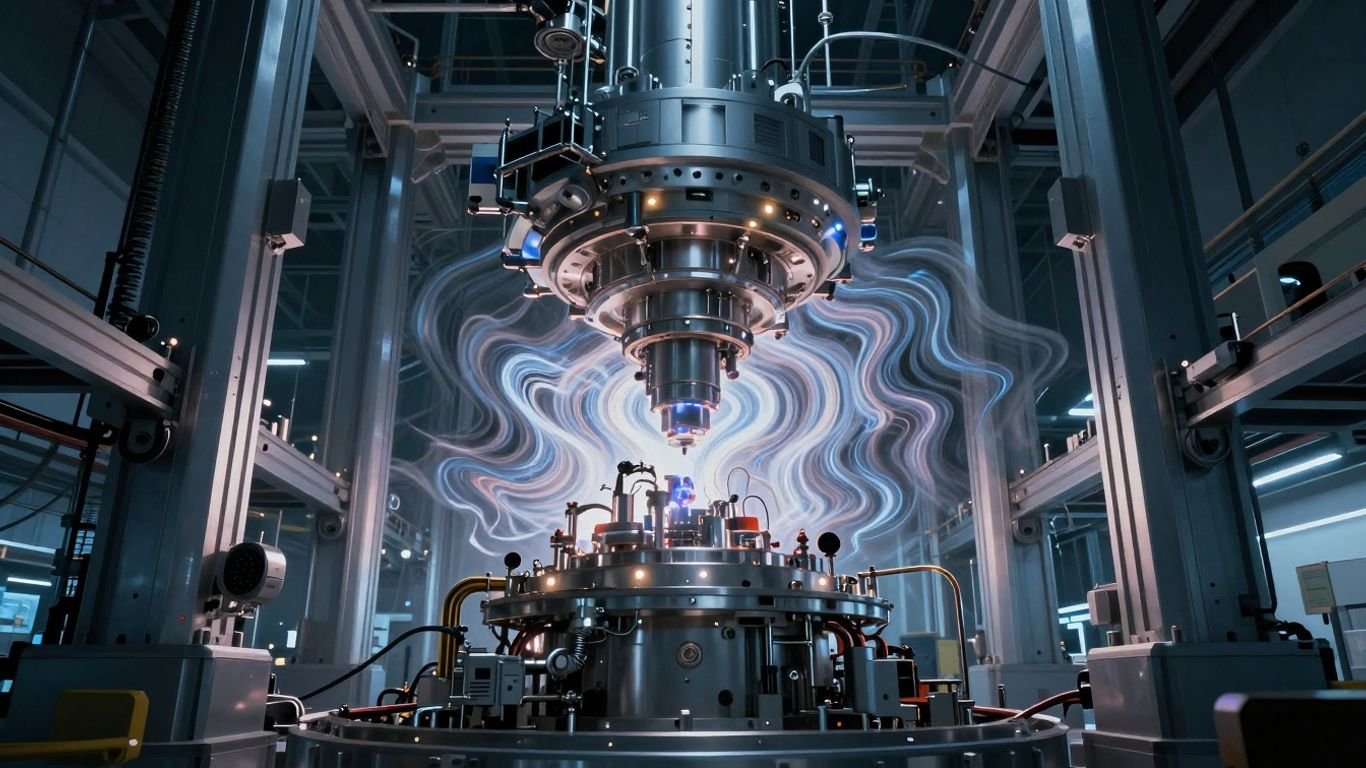

China has achieved a new milestone in scientific research with the construction of CHIEF1900, a record-breaking hypergravity machine designed to simulate extreme conditions. This colossal centrifuge will enable scientists to compress space and time, allowing for the study of catastrophic events like dam failures and earthquakes in a controlled laboratory setting.
A New Era of Hypergravity Research
The newly developed CHIEF1900, constructed by Shanghai Electric Nuclear Power Group, is set to revolutionize hypergravity research. Shipped to Zhejiang University on December 22 for installation, this advanced centrifuge will allow researchers to recreate and study phenomena that would typically take decades or span vast distances. By generating forces hundreds or thousands of times stronger than Earth’s gravity, scientists can effectively compress time and distance within the lab.
Pushing the Boundaries of Scientific Simulation
With a capacity of 1,900 g·tonne, CHIEF1900 significantly surpasses the previous world record holder, CHIEF1300, which has a capacity of 1,300 g·tonne. For context, a household washing machine rarely exceeds 2 g·tonne during its spin cycle. The CHIEF1300 itself had recently dethroned the US Army Corps of Engineers’ machine, which had a capacity of around 1,200 g·tonne.
Both CHIEF1300 and the new CHIEF1900 are integral parts of the Centrifugal Hypergravity and Interdisciplinary Experiment Facility (CHIEF). This national laboratory is situated 15 meters beneath the Zhejiang University campus to minimize vibrations and ensure operational stability.
Applications and Future Potential
The CHIEF complex, approved in 2021 with a budget of 2 billion yuan (US$285 million), represents China’s commitment to advancing its scientific infrastructure and promoting global research partnerships. The facility is accessible to researchers from universities, research institutes, and industries, both domestically and internationally.
The ability to simulate extreme gravitational forces has profound implications. For instance, scientists can accurately assess the structural integrity of large-scale projects like dams by using scaled-down models spun at high g-forces. A three-meter model of a 300-meter tall dam, when spun at 100g, would experience stress levels equivalent to the full-scale structure in real-world conditions, allowing for rigorous testing and analysis within a controlled environment.