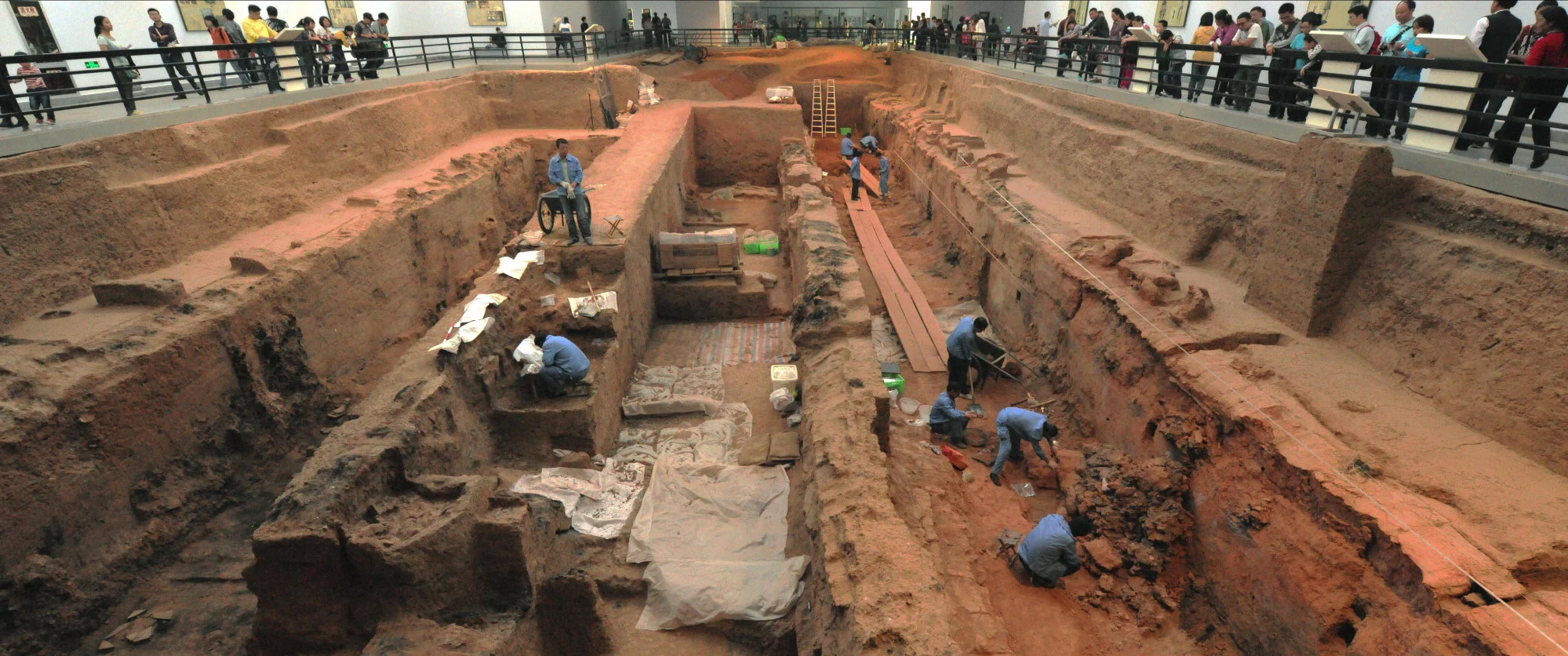

Fifty years ago, in March 1974, farmers digging a well in Shaanxi province, northwest China, stumbled upon fragments of clay figures, leading to one of the greatest archaeological discoveries of all time. Beneath the surface lay an extraordinary underground city guarded by an army of life-size terracotta figures, buried for over 2,000 years.
To date, 8,000 statues have been unearthed, primarily depicting soldiers but also including servants, entertainers, and horses. The excavation also revealed bronze chariots, water birds, weapons, ritual vessels, jade jewelry, and gold and silver trinkets, all part of a sprawling mausoleum built to protect China’s first emperor, Qin Shi Huang, in the afterlife.
“Mysteries of the Terracotta Warriors,” a new Netflix documentary by British director James Tovell, delves into the excavation efforts and the history behind the ancient tomb, as well as the rise and fall of the Qin dynasty (221-207 BC), which Qin Shi Huang founded. The film features Qin historian Professor Lo Yuet Keung, who suggests that the sculptures’ hyperrealistic faces, each unique, are modeled after real people from across China. This likely reflects the emperor’s vision of unifying a diverse empire, symbolizing strength through unity.
“If we did not have the first emperor, it is possible that China would have continued to be divided among different states, much like divided Europe today,” Lo explains.
Currently one of the most-watched movies on Netflix in Hong Kong, “Mysteries of the Terracotta Warriors” portrays the mausoleum of Qin Shi Huang as a vast, preserved site akin to a giant crime scene. Archaeologists use forensic evidence to piece together the past, uncovering the brutal history behind the construction. The complex was built by over 700,000 laborers, effectively prisoners of war from conquered states.
The documentary also seeks to reveal details about the real-life warriors buried alongside the emperor. Despite the extensive excavation, Qin Shi Huang’s tomb remains sealed due to concerns about potential damage and possible booby traps. Qin historian Hui Ming Tak discusses the enormity of the burial site, describing it as a 60 square kilometer mausoleum complex, equivalent in size to Manhattan.
“It is astonishing to think that this was built for one man,” Hui remarks.
“Mysteries of the Terracotta Warriors” combines period-drama-style re-enactments with documentary-style interviews, shedding light on the epic burial site and the historical significance of the Terracotta Army. Through this blend, the film captures the grandeur and mystery of one of history’s most remarkable archaeological discoveries.
READ MORE: