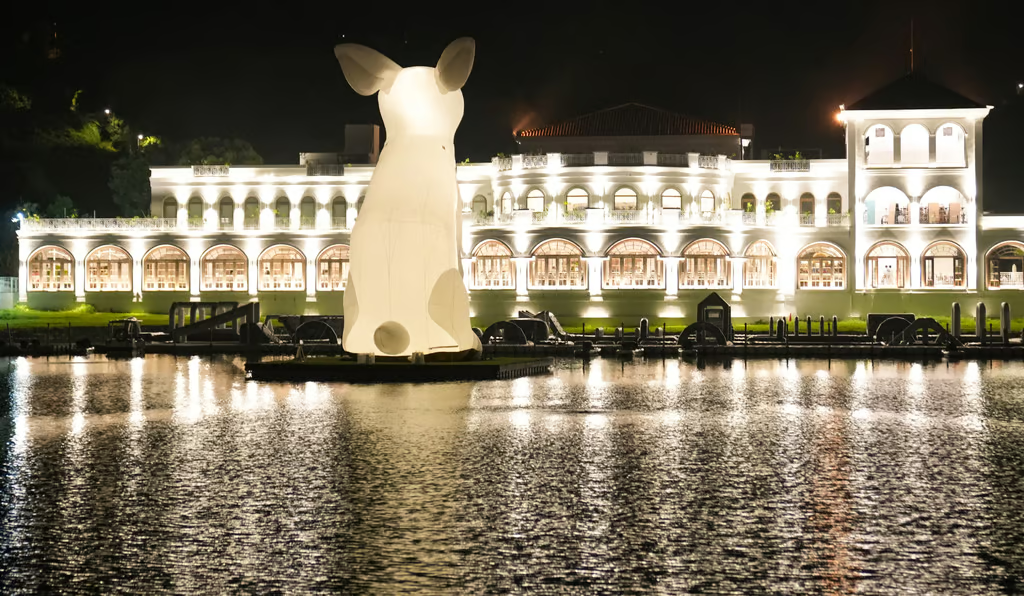

Throughout history, civilizations across the globe, from the Mayans and Greeks to the Chinese, have revered the moon. These ancient societies created myths and legends inspired by their deep respect for nature and the mysteries of the night sky. One such enduring legend is that of the moon rabbit, a symbol present in Chinese mythology and other cultures worldwide.
In many parts of Asia, particularly China, the Mid-Autumn Festival is a time to celebrate the autumn harvest and give thanks. Key traditions include moon-gazing, lighting lanterns, and sharing mooncakes. Central to Chinese mythology is the tale of Chang’e, the goddess who resides on the moon with her companion, the Jade Rabbit (Yu Tu). While Chang’e is well-known, the lore of the Jade Rabbit is equally captivating and has become a symbol closely linked with the Mid-Autumn Festival.
According to Chinese myth, the Jade Emperor, the Ruler of Heaven, sought an animal to help create a powerful potion of immortality. Disguised as a starving man, the emperor asked several animals for food. The rabbit, demonstrating selflessness, offered its own life by leaping into the fire. As a reward for its virtue, the rabbit was elevated to the Moon Palace, where it now helps create potions of immortality.
This tale has roots in ancient Buddhist texts, such as the Jataka, which tells a similar story of a rabbit’s sacrifice, leading to its image being drawn on the moon. Variations of this myth spread throughout East Asia and even influenced indigenous North and Central American folklore, where people also claim to see a rabbit on the moon.
The widespread nature of the moon rabbit legend can be attributed to pareidolia, the human tendency to see familiar shapes in random patterns, like the lunar surface. In East Asian cultures, the moon rabbit is often depicted with a mortar and pestle, either making medicine, rice cakes, or other magical potions.
This enduring symbol even made its way into modern times. During the 1969 Apollo 11 mission, NASA astronauts humorously referenced the Chinese myth of Chang’e and the Jade Rabbit while on their journey to the moon.
While no trace of the mythical rabbit or moon goddess was found by the astronauts, the enchanting tales continue to be celebrated. The moon rabbit remains a beloved cultural figure, particularly during the Mid-Autumn Festival, a time of reflection, togetherness, and reverence for the moon.
READ MORE: