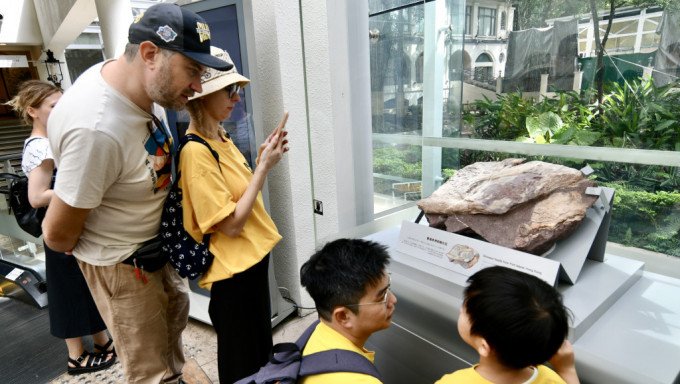

Hong Kong has unveiled its first dinosaur fossils, discovered on the small, uninhabited Port Island, an area known for its striking red rock formations. These fossils, dating back to the Cretaceous period between 145 million and 66 million years ago, represent a breakthrough for paleontology in Hong Kong. Although further analysis is required to identify the species, initial findings suggest they came from a large vertebrate, according to city officials.
The discovery, which was announced earlier this year by Hong Kong’s Agriculture, Fisheries and Conservation Department, adds a new dimension to the city’s natural history. Port Island’s sedimentary rock formations have long been recognized as geologically significant, but the recent fossil discovery indicates a promising new area of study. To further research these fossils, Hong Kong has collaborated with China’s Institute of Vertebrate Paleontology and Paleoanthropology (IVPP), which is one of the world’s leading institutions in dinosaur research. This partnership marks a significant step forward in understanding the palaeoecology of the region.
Michael Pittman, an assistant professor at the Chinese University of Hong Kong’s School of Life Sciences, expressed excitement about the fossils’ potential to elevate local scientific research. “This discovery adds to Hong Kong’s strong track record in dinosaur research and may inspire greater interest in science and nature within our community,” Pittman noted, highlighting the hope for future scientific breakthroughs and engagement.
The fossils made their debut at the Heritage Discovery Centre in Kowloon Park, drawing a crowd eager to witness a slice of prehistory in their city. Among the first visitors was Chong Got, a 66-year-old local resident who arrived early to view the fossils. “It’s shocking because I never thought there would be dinosaur fossils in Hong Kong,” Got shared, echoing the amazement felt by many attendees.
Hong Kong joins Argentina, Canada, the United States, and China in contributing significant fossil discoveries to the field of paleontology. The city’s unique geological formations and history make it a valuable site for further exploration, and officials hope the discovery will inspire more scientific curiosity and outreach within the local community.
With plans for ongoing studies led by the IVPP, Hong Kong’s paleontological community looks forward to uncovering more details about the ancient creatures that once roamed this region, paving the way for a deeper understanding of the city’s prehistoric landscape.
READ MORE: