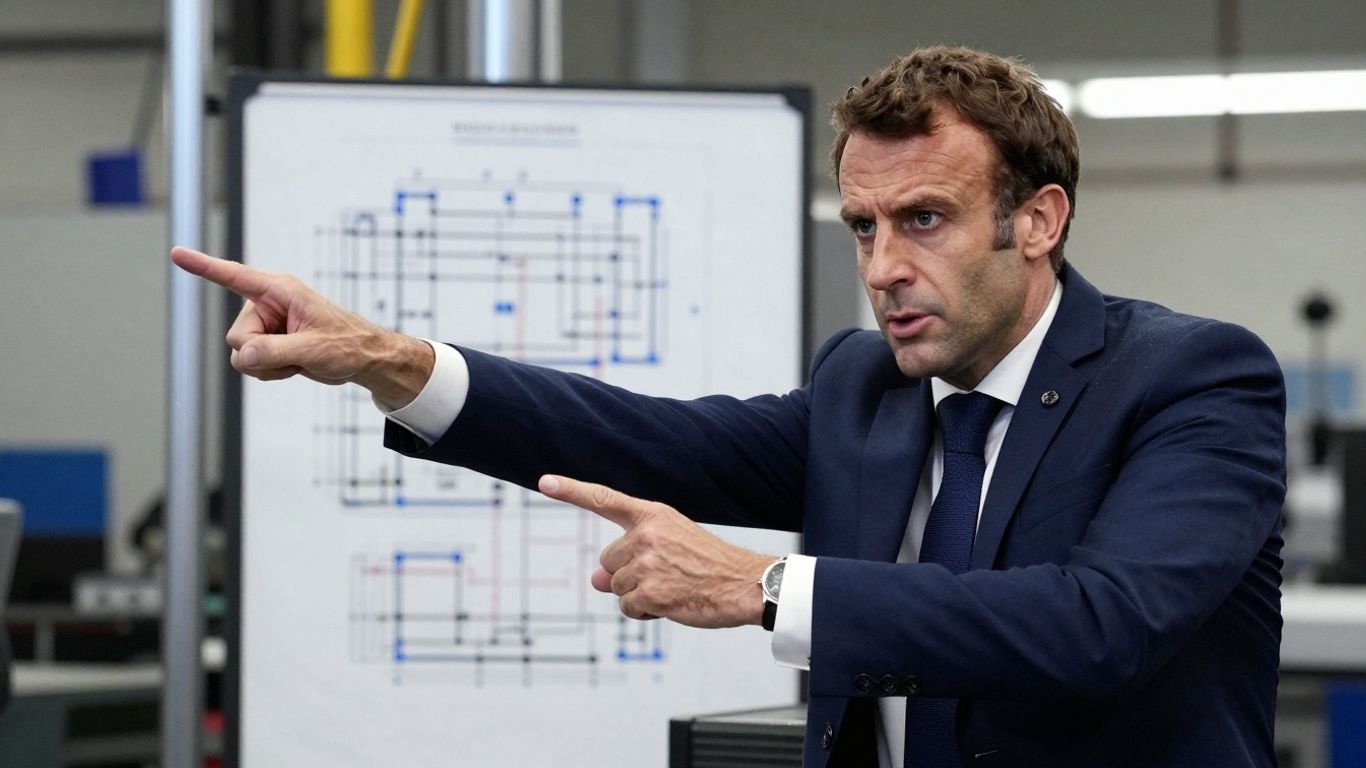

French President Emmanuel Macron has issued a stark warning to the nation’s defense industry, signaling that France may look to European partners for military equipment if domestic firms fail to deliver faster and more efficiently. Speaking at the Istres Air Base, Macron emphasized the need for increased speed and production in a volatile global landscape.
Macron stressed that “to remain free, one must be feared,” and to be feared, France must be powerful. This power, he argued, requires acting faster and striking harder in a “brutal world.” He specifically called on defense manufacturers to “go faster, go stronger, mass produce, produce lighter, respond to demands.” The president made it clear that French armed forces should not be considered captive customers, as the nation might explore “European solutions if they are faster or more efficient.”
The president reiterated France’s commitment to accelerating its defense budget, aiming to reach €64 billion by 2030, three years ahead of schedule, with an additional €3.5 billion allocated for 2026. The updated military spending law for 2026-2030 will see a €36 billion increase. Key priorities include bolstering ammunition stockpiles, enhancing operational readiness, and strengthening military space assets and air defenses. Macron also highlighted the importance of developing very long-range strike capabilities, particularly in light of Russia’s missile capabilities.
Macron acknowledged specific areas where France lags, notably in drone technology. He pointed to the rapid innovation seen on the Ukrainian battlefield, where “partners and manufacturers from other nations moved faster than we did.” He contrasted France’s limited drone production with Ukraine’s output of millions of drones in 2025, urging for a more agile approach.
While France traditionally relies on domestic suppliers, Macron’s remarks signal a potential shift towards greater European integration in defense procurement. He emphasized the need to be “more European in our own purchases” and highlighted collaborative projects, such as the French-German Joint Early Warning for a European Lookout project. The goal is to reduce dependencies on non-European suppliers and consolidate the space dimension of France’s military strategy. The SAMP/T air-defense system was cited as an example of a French-Italian system that could be more widely adopted by European countries to bolster strategic autonomy.